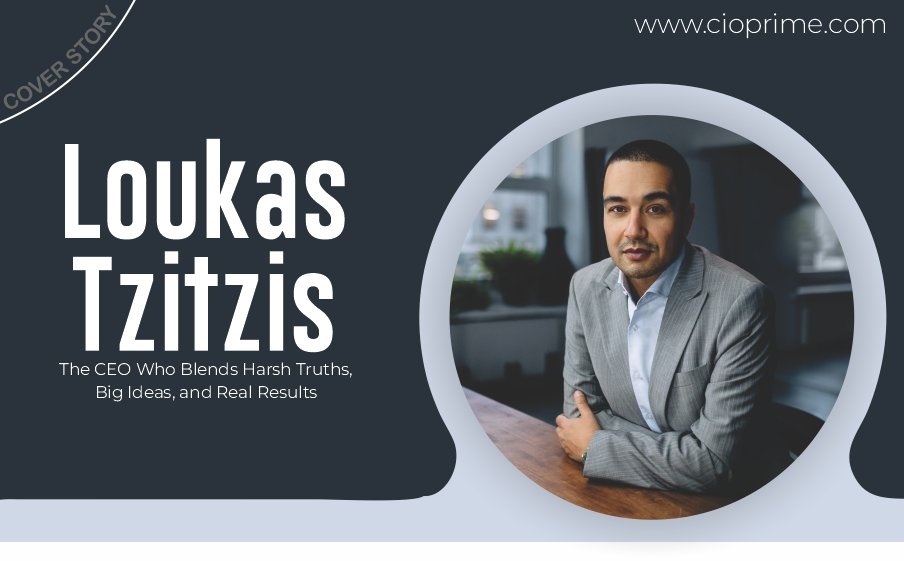
Loukas Tzitzis: The CEO Who Blends Harsh Truths, Big Ideas, and Real Results
Connecting strategy, technology, and leadership to inspire organizations to embrace transformation and growth!
Change often begins with curiosity, the willingness to explore new paths, and the courage to try something different. It can be a small step that grows into a movement, a simple idea that transforms the way people live and work. Loukas Tzitzis embodies this spirit. For over 25 years, he has turned curiosity into action, forming technology and business across 5 continents.
Below are the highlights of the interview:
Loukas, you’ve spent more than 25 years working across five continents in technology and business. What initially motivated you to focus on transformation?
Early in my career, I realized that transformation is fundamentally a competitive advantage. Organizations that adapt quickly thrive; those that resist inevitably fall behind. I saw this pattern repeated across industries, regions, and market cycles. That insight shaped my philosophy: transformation shouldn’t be reactive — it should be strategic, intentional, and continuous. Helping companies stay ahead of change, rather than respond to it, became a core driver in my career and remains central to the work I do today.
You recently received the 2025 Global Recognition Award. What does this award represent for you?
Awards are always appreciated, but for me, they are never about the individual. In our part of the world, success is something we share — with our teams, our partners, and everyone who worked alongside us. Any recognition I receive is really a reflection of their dedication and resilience.
What matters far more than a trophy is what industry leaders, customers, partners, and employees say about you when you are not in the room. Their trust, their confidence, and their willingness to work with you again — that is the real measure of a leader’s impact.
So, while the award is an honour, I see it as recognition of the collective effort: the teams that delivered under pressure, the partners who believed in us, and the clients who placed their trust in our ability to transform their business. That is what truly matters.
How would you describe your leadership style?
Demanding but fair. I set high expectations around professionalism, performance, accountability, and clarity of results. But I balance this with a genuine commitment to developing people and enabling their success.
My leadership principles include:
- transparency and direct communication
- empowerment and mentorship
- adaptability and resilience
- ownership of outcomes
- collaboration built on trust
People deserve clarity about the mission, priorities, and standards. When expectations and support coexist, teams can operate with confidence and deliver at a high level.
What role does motivation play in building high-performing teams?
Motivation becomes powerful when people feel connected to a purpose. Early in my career, I learned that when leaders genuinely engage with their teams, people no longer rely on external pressure to perform. Alignment replaces push. Individuals contribute because they believe in the mission and trust one another.
A defining example was during the COVID-19 period. My regional team was already under significant strain, leading a major transformation program and executing a turnaround. Then the pandemic added extreme personal and operational challenges. I, like many colleagues, was separated from my children for nearly two years.
Despite these conditions, the team achieved results not seen in the region for almost a decade and rebuilt relationships with critical customers. Their resilience validated what I believe about servant leadership: leaders must support their people, especially in difficult circumstances.
When I later returned to Europe, the team surprised me with a farewell gathering and a cricket bat signed by everyone. It was meaningful because it showed that strong expectations and strong relationships can absolutely coexist.
Conflict is inevitable in organizations. How do you approach managing it?
By addressing it early and objectively. Unresolved conflict affects morale, productivity, and trust.
My approach centres on:
- Early intervention — avoiding conflict typically worsens it.
- Neutral, fact-based assessment — focus on behaviours and verifiable information.
- Psychological safety — ensuring people can express concerns without fear.
- Understanding root causes — cultural dynamics, expectations, or structural issues.
- Focusing on interests, not positions — uncovering what people actually need.
- Collaborative solution-building — with clear responsibilities and timelines.
- Consistent follow-up — ensuring commitments are kept and improvements stick
Handled properly, conflict can strengthen relationships and clarify expectations.
Talent development appears central to your leadership philosophy. What does effective development look like to you?
Development must align with the company’s size, culture, and strategic direction. There’s no one-size-fits-all model.
Effective development includes:
- a clear organizational development agenda
- honest evaluation of capabilities
- mentorship and coaching
- structured succession planning
- realistic career pathways
I connect talent aspirations with business needs. When people are in the right roles at the right time — and feel supported — organizations gain agility and long-term strength.
From your perspective, what qualities define a successful leader today?
Leadership is multifaceted and context-dependent, but some qualities are consistently essential:
Clear communication: people need direction, not ambiguity.
- Adaptability: plans change; leaders must adjust quickly.
- Emotional intelligence: understanding people is critical to influencing outcomes.
- Humility: leaders who listen learn more and execute better.
- Outcome orientation: lasting impact comes from delivering results, not activity
In my experience, great leaders combine ambition with disciplined execution.
Your roles at Tech Mahindra and Amdocs involved managing large, complex deals. What did you learn from operating at that scale?
That scale requires precision. Multi-year sales cycles, cross-border contracting, and eight- or nine-figure commercial structures demand discipline and patience.
The key lessons were:
- Large sales are an orchestration challenge, not a persuasion contest
- Financial governance must be rigorous and consistent
- Internal influence is essential — alignment across corporate networks is critica
- execution is what ultimately converts vision into results
Those roles shaped my understanding of global business mechanics and the complexity required to deliver value across markets.
Looking ahead, what technologies do you believe will define the next five years?
The next wave of transformation will come from the convergence of multiple technologies, not a single breakthrough. These include:
- Artificial intelligence — for insight, automation, and speed
- Quantum computing — for unprecedented processing capability
- Web3 — enabling decentralized trust and asset management
- Cybersecurity — ensuring reliability and safety
The true impact occurs when these technologies work together within ecosystems.
In medtech, this will support faster, more personalized diagnostics.
In finance, it will foster secure global transactions, tokenized assets, and inclusive financial systems.
Across utilities and critical infrastructure, it will enable smarter, more resilient, and sustainable operations.
The future will be defined by integrated, intelligent, and secure digital ecosystems.
You speak often about AI as an enabler of opportunity. What do you see as its greatest potential?
AI can expand opportunities in ways previous technologies could not. It can:
- bring advanced diagnostics to underserved communities
- personalize education in resource-limited classrooms
- provide fair access to financial tools
- guide farmers with real-time data
- connect entrepreneurs in emerging markets with global customers
But this potential requires responsible implementation — developing local talent, respecting cultural contexts, and ensuring ethical use. Closing the digital divide is not just about technology; it’s about dignity, opportunity, and economic mobility.
Office Line SA is investing deeply in AI-powered and cybersecure solutions. How does your vision align with the company’s strategy?
Office Line’s strategy is built on three pillars:
- AI-powered and cybersecure managed services and data solutions
- Delivering advanced observability, predictive capabilities, and sustainable digital operations.
- Strong partnerships
Especially with Microsoft, enabling faster, more reliable innovation and transformation. - Client co-creation
Working directly with clients to design solutions that deliver measurable and long-lasting impact
These pillars align closely with my belief that technology must be secure, intelligent, and customer-centric. They also connect directly to the priorities of the markets we serve.
In the Middle East, for example, our focus fits naturally with national agendas such as Saudi Arabia’s Vision 2030 and the UAE’s Vision 2031, both of which emphasize AI adoption, digital government, secure cloud infrastructure, and smart, data-driven economies. Whether supporting digital modernization, strengthening cybersecurity posture, or enabling AI-powered citizen services, our capabilities are built to advance the ambitions of these national strategies. We bring practical experience in areas like predictive analytics, secure cloud migration, and intelligent operations — all of which contribute to the region’s drive toward digital excellence and economic diversification.
At the same time, we take this international experience and apply it to our captive market in Greece. The same frameworks, best practices, and technologies that support national transformation programs in the Middle East are adapted to the needs of Greek enterprises and public organizations. This allows us to raise the technology maturity of the Greek market, accelerate cloud adoption, and deliver AI-driven, secure solutions that support the country’s competitiveness and modernization.
Office Line’s leadership – from the Founders to CEO Panagiotis Kouris and CTO Bill Kraniotis – has built an organization that can operate confidently across regions, contribute to national priorities, and bring global expertise home. Our strategy is not only aligned with where the industry is heading, but also with where countries and organizations want to go.
Mentorship seems to be an important part of your work. Why is it so meaningful to you?
Because mentorship shaped my own career. I had leaders who guided me, challenged me, and believed in me when I needed it most. Their influence stayed with me. I feel a responsibility to offer the same to the next generation.
Within the organization, I invest time in mentoring emerging leaders on strategic thinking, commercial acumen, and resilience. Outside the company, I support academic programs, industry communities, and entrepreneurial networks. Real-world experience shared at the right moment can change someone’s trajectory.
Mentorship is about continuity — passing forward what you were fortunate enough to receive.
Read the full magazine edition: Click Here