
Dr. Anup Dayanand Sadhu: 31 Years of Public Service Across Railways, Logistics, Safety, and Passenger Experience
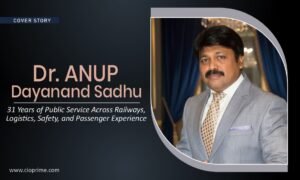
After 31 years of distinguished service in Indian Railways and allied public sector institutions, Dr. Anup Dayanand Sadhu has recently retired, concluding a career that combined operational leadership, policy innovation, logistics development, passenger service reform, and crisis management at national scale.
An officer of the Indian Railway Traffic Service (IRTS), 1993 batch, Dr. Anup served at the Higher Administrative Grade / Principal Secretary level, including assignments equivalent to E9 in public sector undertakings. His work spanned Indian Railways and Container Corporation of India Ltd. (CONCOR), where he held senior leadership roles influencing freight movement, passenger experience, digital systems, safety frameworks, and revenue optimisation.
From medicine to mass mobility
Before railway yards and control rooms, there was medicine. Dr. Anup graduated in medicine at prestigious Bangalore Medical College, followed by an MD in Psychiatry from NIMHANS. The clinical discipline stayed with him long after he left hospitals behind. Reading human behaviour. Managing stress under pressure. Making decisions when the cost of delay is real.
Later, advanced management education at INSEAD and the ICLIF Leadership and Governance Centre added another layer. Strategy, governance, institutional thinking. By the time he entered the Indian Railway Traffic Service in 1993, he was already wired for complexity.
Railways gave him plenty of it.
Learning the system from the ground up
Over the years, Dr. Anup moved through nearly every operational nerve centre of South Western Railway. Safety. Operations. Commercial management. Train running. Division after division, city after city. Bangalore. Mysore. Hubli.
In Bangalore Division, he designed and implemented Rail Safety Management Systems that cut train accidents by more than half. The results were strong enough to earn recognition from the Khanna Committee, but more importantly, they held on the ground.
In freight, he helped run India’s first broad-gauge freight train on the Hassan–Mangalore section after gauge conversion. He introduced single-train coal operations that saved over ₹50 crore. On the demanding Braganza Ghat section, he pioneered GM locomotive operations, eliminating rake splitting and unlocking capacity gains that led to 40 million tonnes of freight loading in a single year, a record that still stands.
These were not headline projects. They were the kind that quietly change what is possible.
Infrastructure followed operations. Railway sidings in Bellary–Hospet. Connectivity that fed the iron ore economy. Each decision tied back to one idea: systems must reflect real demand, not inherited habits.
Digital transformation and revenue systems
Even while freight numbers grew, Dr. Anup paid unusual attention to passenger experience. Not cosmetically, but structurally.
At Mysore Railway Station, he helped introduce India’s first Wi-Fi facility at a station, a PPP-run three-star retiring room, and a Heritage Photo Gallery cum model railroad system that took passenger amenities to the next level. Onboard, he launched India’s first infotainment systems on select trains.
He replotted more than 100 passenger trains using zero-based timetabling, a technical exercise with very human consequences. Faster journeys. Better freight slots. Fewer conflicts.
Later, as Chief Commercial Manager for Passenger Services and Catering at South Western Railway, he oversaw commercial business across multiple states, while also taking charge as Chief Information Security Officer and Chief Claims Officer. Digital adoption surged. Electronic Treasury Remittance crossed 96%. QR-based ticketing reached 20%, the highest among railway zones.
ATVMs accounted for a quarter of ticket sales.
Passenger complaints were not dismissed as noise. Under his coordination, Rail Madad redressal became a measurable performance metric.
Logistics, scaled nationally
At Container Corporation of India Ltd., Dr. Anup stepped into a different rhythm. Ports, customs, depots, supply chains.
As Group General Manager handling Whitefield ICD in Bangalore and later the Ahmedabad and Mumbai clusters, he worked on EXIM logistics that rarely attract public attention but quietly power the economy. Inland container depots. New port linkages. Reefer trains for imported fruit. A ₹100 crore multimodal logistics park at Kadakola and a new container depot at Mangalore Port.
He worked with customs authorities, state governments, and trade bodies. He also contributed to the Karnataka Logistics Action Plan 2022, shaping policy as much as operations.
Freight, for him, was not movement. It was trust. If containers moved reliably, industries planned confidently.
The pilgrimage train that changed the conversation
Then came the Bharat Gaurav Train.
Pilgrimage travel had always existed. What did not exist was a structured, scalable, zone-led model that treated faith travel as both a public service and a viable revenue stream.
Dr. Anup conceptualised and commissioned the Bharat Gaurav pilgrimage trains for South Western Railway, working closely with the Government of Karnataka and IRCTC. The routes connected Kashi, Gaya, Ayodhya, and Rameshwaram. The execution was meticulous.
The results were unmistakable. Thousands of pilgrims travelled who might not have otherwise. Thirty-six trips ran successfully. Nearly ₹20 crore in revenue was generated. South Western Railway set a benchmark that other zones studied closely.
It was not just a train. It was proof that social purpose and financial discipline could coexist without compromise.
This initiative remains his exclusive contribution to the zone, and one of the most publicly visible markers of his leadership.
Leadership in crisis
During the COVID-19 second wave, Dr. Anup coordinated 45 oxygen trains to Bengaluru and served on the Karnataka oxygen distribution committee. He also led large-scale CSR relief efforts, including food distribution and essential supplies.
His humanitarian work received national recognition, including mention in the Prime Minister’s Mann Ki Baat.
He also implemented One Station One Product across 92 stations in South Western Railway, supporting local artisans and farmers, and coordinated a joint parcel product with India Post between Bangalore and Visakhapatnam.
Awards, recognition, and personal interests
Dr. Anup, undoubtedly one of the most awarded IRTS officer in the country, who has received numerous national, organisational, and industry awards, including:
- National Award for Outstanding Service in Administration
- National Tourism Award presented by the President of India
- Multiple General Manager’s Awards
- Pride of India Award in Public Service
- India Icon 2020; India Business Award
- Karnataka Vibhushana Prashasthi Award
- Logistics and innovation awards from CII, FKCCI, Maritime Gateway, and others
Beyond administration, he is an accomplished singer, having performed at the World Kannada Summit in Cincinnati, Yuva Dasara, and other national platforms.
After retirement, the systems remain
With his recent retirement, Dr. Anup Dayanand Sadhu steps away from office, but not from impact. Safety systems continue to function. Freight corridors still carry record loads. Pilgrims continue to travel routes he created. Stations operate under frameworks he put in place.
His career proves one thing clearly: when public systems are led with discipline, imagination, and accountability, they continue to serve long after the leader steps away.
Read the full magazine edition: Click Here