
From Financial Leadership to Human Flourishing: Dr. Ignacio Bonasa Alzuria and the University of Happiness and Well-Being
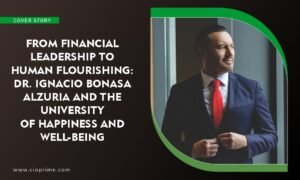
“The future of leadership will not belong only to those who manage resources, but to those who know how to awaken meaning, dignity, creativity, and well-being in people.”
There are leaders who build companies, and there are leaders who build a new language for the future of companies. Dr. Ignacio Bonasa Alzuria belongs to the second category. After a distinguished executive career in banking and business leadership, he made a decision that would define his legacy: to move from managing systems to transforming people; from measuring performance only through figures to understanding performance as the visible consequence of meaning, culture, emotion, and purpose.
Today, as President and Founder of the University of Happiness and Well-Being and President and Founder of Liderarte, Dr. Bonasa has emerged as a distinctive Spanish voice in the international conversation on humanistic leadership, organizational well-being, and talent development through art. His work does not treat happiness as a superficial corporate slogan. He approaches it as a strategic discipline, a cultural architecture, and a measurable human aspiration. For him, the organization of the future will not be the one that simply hires talent, but the one that learns how to care for it, inspire it, develop it, and give it a reason to stay.
His journey is the story of a leader who understood that one of the defining challenges of this new era is not merely digital acceleration, artificial intelligence, or global competition. The deeper challenge is whether organizations will remain human while becoming more efficient. Through the University of Happiness and Well-Being, Liderarte, and his broader ecosystem of initiatives, Dr. Bonasa proposes a bold answer: companies must become places where results and soul are not enemies, where art becomes a vehicle for learning, and where leadership is measured not only by what it achieves, but by what it awakens in people.
He spoke with The Prime Today about his journey, his philosophy, and his future plans for Liderarte and the University of Happiness and Well-Being.
Dr. Bonasa, your journey from banking executive to founder of Liderarte is remarkable. What inspired this transformation, and how has it shaped your leadership philosophy?
My transformation was not a sudden break with my past. It was the natural evolution of a life spent observing people, power, ambition, fear, talent, and meaning from very different angles. Banking gave me discipline, strategy, execution, risk awareness, and a deep understanding of organizations. It taught me how decisions are made, how pressure operates, and how results are built. But it also showed me something even more important: numbers never explain the whole truth of an organization. Behind every result, there are people; behind every person, there is an emotional world; and behind every sustainable success, there must be purpose.
At a certain moment, I understood that my mission was no longer only to lead structures, but to help human beings reconnect with their own capacity to lead themselves and others. That is the origin of Liderarte and, later, the deeper institutional expression of that vision: the University of Happiness and Well-Being. As President and Founder of the University, I want to place well-being, happiness, art, human development, and organizational transformation at the center of executive education. This conviction has shaped my leadership philosophy: leadership is not the art of dominating, but the art of awakening. A leader must generate results, of course, but results with soul, results that do not destroy the human fabric that makes them possible.
What is the core mission of Liderarte, and how has it evolved since its founding?
The core mission of Liderarte is to develop talent, leadership, and organizational culture through art, emotion, and experiential learning. We were born from a clear intuition: people do not transform only because they receive information; they transform when something moves them inside. Art has the power to do that. It opens symbolic, emotional, and creative spaces where people can see themselves differently, understand others more deeply, and rehearse new ways of acting.
Over time, Liderarte has evolved from a pioneering training and development initiative into a broader ecosystem of transformation. It now connects leadership, well-being, creativity, values, purpose, organizational culture, and social impact. The University of Happiness and Well-Being gives academic, institutional, and international projection to that belief: happiness and well-being are not peripheral issues. They are central to productivity, innovation, ethics, and sustainable business performance. Liderarte activates transformation inside organizations; the University gives that transformation a broader intellectual and educational home.
You are known for integrating art into leadership development. Why do you believe art is such a powerful tool for organizational transformation?
Art is powerful because it speaks to the whole person. Traditional corporate learning often works only with the rational dimension: concepts, frameworks, slides, metrics. Those tools are useful, but insufficient. Human beings also learn through emotion, beauty, metaphor, movement, music, silence, narrative, and shared experience. Art creates a different kind of learning because it bypasses defensive routines. It allows a senior executive to see vulnerability without losing authority; a team to experience harmony and dissonance; an organization to understand culture not as a diagram, but as a living composition.
When a team works with music, theatre, painting, opera, literature, or creative expression, something very significant happens: people stop speaking only from their role and begin speaking from their humanity. That is where transformation starts. Art helps organizations move from mechanical coordination to emotional resonance. It reveals how leadership sounds, how trust feels, how conflict is staged, and how purpose can be embodied. This is why, for Liderarte and the University of Happiness and Well-Being, art is not decoration. It is methodology. It is a bridge between knowledge and consciousness, between strategy and soul, between learning and action.
How do you define “leadership with soul,” and why is it increasingly relevant in today’s business environment?
Leadership with soul is the capacity to achieve results without losing humanity. It means leading with clarity, courage, and ambition, but also with dignity, empathy, coherence, and care. A leader with soul does not confuse authority with distance, speed with direction, or success with exhaustion. This kind of leadership is increasingly relevant because organizations are facing a paradox: they need to be more technological, more agile, and more competitive, while people are asking for more meaning, more respect, and more well-being.
The leaders of this new era cannot rely only on command-and-control models. They need to create environments where people feel seen, heard, and challenged in a healthy way. Leadership with soul is not soft. It is demanding, but not dehumanizing. It is strategic, but not cynical. It is emotionally intelligent, but not sentimental. From the University of Happiness and Well-Being, I defend the idea that well-being is a leadership responsibility. A company that ignores the inner life of its people will eventually pay the price in disengagement, burnout, poor creativity, and weak loyalty. Leadership with soul is the antidote to that silent organizational erosion.
What are the biggest leadership challenges facing Spanish organizations as they prepare for 2026 and beyond?
Spanish organizations face several interconnected challenges. The first is cultural transformation. Many companies have modernized their technologies, but not always their leadership mindsets. Digital tools can move faster than human cultures, and that creates tension. The second challenge is talent loyalty. People no longer want only employment; they want belonging, development, flexibility, recognition, and purpose. The third challenge is well-being. Stress, emotional fatigue, and uncertainty are not marginal issues. They are strategic risks.
Spain has enormous strengths: creativity, relational intelligence, resilience, entrepreneurial energy, cultural depth, and a strong sense of life. But we must convert these qualities into a competitive advantage. To do that, organizations need leaders capable of integrating performance with humanity. They need to stop treating well-being as a benefits package and start treating it as a leadership model. This is one of the reasons I founded the University of Happiness and Well-Being: to help Spain and the international business community understand that the future of excellence will be humanistic, or it will not be sustainable.
How can companies balance business performance with employee well-being and purpose?
The first step is to stop seeing performance, well-being, and purpose as three separate agendas. They are deeply connected. Sustainable performance depends on energy, trust, clarity, motivation, and psychological safety. Well-being is not the opposite of productivity; it is one of its conditions. Purpose is not a slogan on a wall; it is the emotional reason why people invest their talent beyond the minimum required.
Companies can achieve this balance by translating purpose into daily practices. That means leaders who listen, meetings that respect time, goals that are ambitious but meaningful, recognition that is sincere, development paths that are real, and cultures where people can speak without fear. It also requires measurement. The University of Happiness and Well-Being promotes the idea that happiness and well-being must be approached with seriousness: through models, indicators, learning journeys, and leadership accountability. A company cannot claim to care for people if care is not designed, practiced, and evaluated.
What role does emotional intelligence play in building high-performing teams and sustainable organizations?
Emotional intelligence is the invisible infrastructure of high performance. Technical competence may bring people into a room, but emotional intelligence determines whether they will collaborate, trust, create, and stay. Teams fail not only because they lack knowledge, but because they do not know how to manage fear, ego, conflict, frustration, or silence. A brilliant strategy can be destroyed by a poor emotional climate.
In sustainable organizations, emotional intelligence operates at several levels. At the personal level, it helps leaders understand their own reactions. At the interpersonal level, it improves listening, feedback, and conflict resolution. At the cultural level, it creates conditions for psychological safety, inclusion, and shared responsibility. For me, emotional intelligence is not a decorative skill. It is a strategic competence. In the future workplace, the best leaders will not be those who feel less, but those who understand more deeply what emotions are telling the organization before the financial indicators become irreversible.
Which leadership qualities will be most essential for success in the future workplace?
The future workplace will demand leaders who combine apparently opposite qualities. They will need strategic vision and human closeness; technological literacy and ethical judgment; speed and reflection; ambition and care; creativity and discipline. Above all, they will need coherence. People are increasingly sensitive to the distance between what leaders say and what leaders do.
I believe five qualities will be essential. The first is self-awareness, because leaders who do not know themselves tend to project their unresolved issues onto their teams. The second is empathy with boundaries, because caring does not mean avoiding difficult decisions. The third is creativity, because the future cannot be managed only with the formulas of the past. The fourth is courage, especially the courage to humanize business when dehumanization seems more efficient. The fifth is purpose-driven execution. Dreams without execution are poetry; execution without purpose can become machinery. The leader of the future must integrate both.
What lessons have you learned from working with leaders across different industries and sectors?
One of the most important lessons is that leadership problems are often more human than technical. Different sectors have different languages, regulations, and markets, but the underlying questions are remarkably similar: How do we build trust? How do we manage uncertainty? How do we align people? How do we face conflict? How do we keep meaning alive when pressure increases?
I have also learned that many leaders carry a private loneliness. They are expected to inspire, decide, and remain strong, but they are not always given spaces to reflect on their own fears, doubts, and emotional fatigue. That is why leadership development must go beyond tools and competencies. It must include identity, purpose, and inner strength. Through Liderarte and the University of Happiness and Well-Being, I try to create those spaces: rigorous, but human; strategic, but soulful; practical, but transformative. Leaders do not only need new methods. Sometimes they need permission to reconnect with the person behind the position.
How do you foster innovation and creativity within organizations while maintaining strategic focus?
Innovation without focus becomes dispersion; focus without creativity becomes rigidity. The key is to design spaces where imagination and strategy can speak to each other. Organizations need disciplined creativity: the capacity to explore new possibilities while remaining connected to mission, priorities, and measurable impact.
At Liderarte, we often use artistic processes to activate this disciplined creativity. Art teaches that creation is not chaos. A symphony, a painting, a theatrical performance, or a poem requires structure, listening, rehearsal, courage, and editing. The same is true in business. Creativity needs freedom, but also a frame. It needs emotional safety, but also ambition. The role of leadership is to create the conditions where people dare to think differently and then translate that difference into action. At the University of Happiness and Well-Being, we connect this approach with broader models of human flourishing because creativity grows where people feel alive, respected, and meaningful.
What opportunities do you see for Spain to strengthen its position as a leader in talent development and organizational excellence?
Spain has a unique opportunity to become an international reference in humanistic talent development. We have cultural richness, artistic heritage, relational intelligence, creativity, emotional expressiveness, and a strong capacity for adaptation. These are not secondary assets. In an age of artificial intelligence, the most human qualities become more valuable, not less.
To strengthen its position, Spain must be bold. It must connect business schools, universities, companies, cultural institutions, associations, and social movements around a new agenda: talent with purpose, leadership with soul, and organizations that care without renouncing excellence. The University of Happiness and Well-Being was created precisely to contribute to that agenda. I want Spain to export not only products and services, but also a way of understanding leadership in which performance, beauty, ethics, well-being, and social responsibility are part of the same conversation. That could become a distinctive Spanish contribution to the world of management.
What legacy do you hope to create through your work and the impact of Liderarte?
My desired legacy is not only an organization, a methodology, or a list of programs. My true legacy would be to have helped restore soul to places where it had been forgotten. If, through Liderarte, the University of Happiness and Well-Being, and my broader work, I can help leaders understand that people are not instruments but sources of meaning, then my work will have been worthwhile.
I would like to be remembered as someone who defended the idea that business can be profitable without becoming empty; that leadership can be strong without becoming cold; that art can enter organizations not as entertainment, but as transformation; and that happiness can be approached with depth, rigor, and dignity. I do not want to create followers. I want to awaken leaders who lead themselves, care for others, and build organizations that leave people better than they found them.
What message would you like to share with the next generation of business leaders who aspire to create meaningful and lasting change?
My message is simple: do not lose your soul on the way to success. The world will invite you to go faster, accumulate more, impress more, and compete more. But the most important question is not only what you will achieve. It is who you will become while achieving it, and what will happen to the people who walk beside you.
Learn strategy, finance, technology, and execution. They are essential. But also learn to listen, to pause, to contemplate beauty, to understand pain, to manage your ego, and to lead with gratitude. The next generation has the opportunity to build companies that are not only more intelligent, but more conscious; not only more global, but more human. If they understand that well-being is not weakness, that purpose is not naivety, and that leadership is a moral responsibility, they will not only transform organizations. They will help transform society.
When I look at the future, I do not see only markets, technologies, or institutions. I see people searching for meaning. I see professionals who want to be useful without becoming exhausted; leaders who want to be admired without losing tenderness; organizations that want results but also want to be worthy of the people who make those results possible.
That is why the University of Happiness and Well-Being is not just another project in my life. It is a declaration of purpose. It is my way of saying that happiness deserves a university, that well-being deserves a strategy, that art deserves a place in leadership, and that the soul deserves a seat at the table where the future of business is being decided.
My deepest aspiration is that one day, when people speak about great companies, they will not refer only to their size, valuation, or market share, but also to the dignity they generated, the talent they awakened, the lives they improved, and the hope they gave back to society. That, for me, is the real measure of leadership. That is the future I want to help build.
Read Also : Christophe T. Spring: The Global Leader Who Never Lost Sight of People