
Dr. Saji PK: The Architect of Digital Bridges
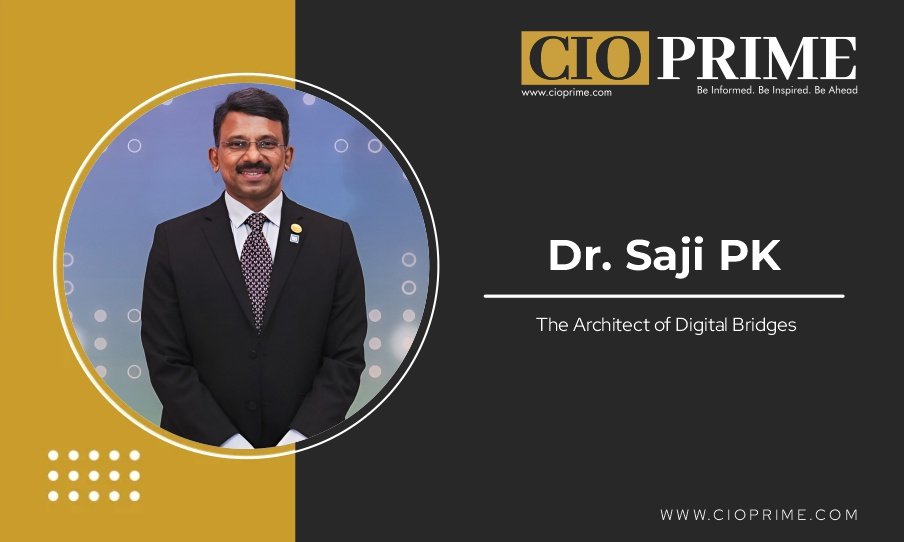
Turning Curiosity and Commitment into Technology That Connects and Empowers!
In a small town, life often moves slowly, but the lessons it teaches can last a lifetime. The rhythm of daily chores, the respect for elders, and the value of persistence shape who we become. For Dr. Saji PK, these early lessons in Kerala became the blueprint for his life.
From childhood, he carried a deep curiosity and a belief that learning could open doors. Technology caught his attention not because it was modern or fashionable, but because it offered a way to make a real difference. In the early 1990s, when computers were rare in India, he saw their power to transform industries and improve lives. His first project, an internship developing simulation software for the Indian Air Force, taught him that technology could do more than simplify tasks; it could save lives. That moment defined his purpose.
Over the next 3 decades, Dr. Saji contributed to organizations such as Sify, Tata Communications, Airtel, and Amazon Web Services, helping build digital infrastructures that connect communities and economies. Each project reinforced his belief that technology is a bridge between people, opportunities, and progress.
What drives him is not recognition or accolades, but the chance to use his skills to serve and empower others. Every system he builds, every solution he designs, carries the intent to make life easier, safer, and more connected.
Dr. Saji’s journey shows that when curiosity meets purpose, and knowledge meets dedication, technology becomes more than tools and networks. It becomes a bridge that changes lives.
When you reflect on your own journey, what early life experiences most shaped your perspective on what it means to be a leader?
Growing up, I was often placed in situations where I had to take responsibility early, whether it was coordinating community initiatives or helping others navigate challenges.
During my early days as an intern, I was entrusted with developing an animation package to support the training of Indian Air Force pilots.
At the time, I may not have fully realized it, but that experience crystallized some of my core values as a leader. As a young student, I was given a responsibility far greater than I anticipated. The code I wrote was not just software; it was part of a system that pilots would rely on in their preparation. It was the first time I understood that leadership is inseparable from responsibility, and that the true measure of leadership lies in the impact one has on others. That experience has continued to shape my philosophy: leadership is not defined by position or title, but by service, accountability, and the ability to create clarity in moments of ambiguity.
How has your understanding of leadership evolved as you moved through different stages of your career and personal life?
In my early professional years, leadership was about competence. At Zenith Computers and Citibank, I learned that trust is earned by solving problems quickly and reliably. People followed you when they could count on you.
At Sify, as I helped build India’s first large-scale internet backbone and data centers, leadership became about vision. I wasn’t just solving problems; I was asking my teams to imagine a connected India and to work toward it against enormous odds.
At Tata Communications, my scope expanded globally. Here, I learned that leadership was about empowerment, uniting diverse teams across cultures, aligning them toward common goals, and building frameworks where every voice mattered.
At AWS, with thousands of professionals spread across continents, I’ve come to see leadership as stewardship. It’s no longer about personal contribution, but about creating safe, resilient, and innovative systems while developing the next generation of leaders.
On a personal note, my time at IIM Ahmedabad reshaped me profoundly. It taught me that leadership is not about always having the answers but about having the humility to unlearn, to adapt, and to evolve alongside others.
Can you describe a pivotal moment when your leadership was truly tested, and what inner resources you drew upon to navigate it?
One of my toughest leadership moments was during a large-scale operational disruption. It required composure, rapid decision-making, and constant communication with teams under pressure. What helped me was my ability to stay anchored in values, transparency, trust, and accountability, and to draw strength from the collective resilience of the team.
In your view, what qualities distinguish leadership from authority, and how do you personally embody that distinction?
Authority is positional; it is granted by a title. Leadership is relational; it is earned through trust and service. Authority can command compliance, but leadership inspires commitment.
Throughout my career, I have tried to embody this distinction by focusing on empowerment rather than control. At Tata, I made sure that local teams felt ownership of global projects, so decisions weren’t bottlenecked in one office but distributed across capable leaders. At AWS, I emphasize creating environments where even the most junior engineer feels their contribution is valued and essential.
For me, leadership is not about how loudly you speak, but about how deeply you listen. It’s not about visibility in the spotlight, but about helping others find their light.
How do you reconcile the tension between staying true to your values and adapting to organizational or societal pressures?
I’ve always relied on what I call my “values anchor.” Integrity, service, and accountability are non-negotiable; everything else is adaptable. When pressures come, to prioritize speed over safety, or profits over sustainability, I ground myself in those values.
Reconciling doesn’t mean refusing change. It means adapting methods while protecting principles. At times, this has required difficult conversations and slower paths. But in the long run, organizations thrive when values aren’t compromised. I have seen that being consistent in values builds the trust that enables teams and stakeholders to stand with you, even in high-pressure moments.
When you look back, is there a decision or action you took as a leader that still makes you uncomfortable, and what did you learn from it?
There was a time when I prioritized results over relationships in a high-pressure situation. While the outcome was positive, I later realized the long-term cost on trust. That experience taught me that “how” we achieve results is as important as “what” we achieve.
How do you cultivate trust with the people who look to you for guidance, especially when the path forward is uncertain?
Trust is not built in moments of success; it is built in moments of uncertainty. I cultivate it by being transparent, consistent, and present. I don’t pretend to have all the answers, but I do make sure people know I am walking the path with them.
At my current job, with teams spread across regions and time zones, uncertainty is part of daily life, whether it’s a system outage, a regulatory change, or a new innovation. I make it a point to communicate openly, to share what we know and what we don’t, and to demonstrate through action that I will stand by my teams until the challenge is resolved.
Can you share an instance where someone challenged your perspective as a leader, and how that moment influenced your trajectory?
During my program at IIM Ahmedabad, I was challenged by peers who were much younger and more attuned to ambiguity than I was. My instinct was to control uncertainty, to structure it. They argued that ambiguity is not something to be eliminated but embraced.
That challenge shifted my perspective. It pushed me to let go of my attachment to certainty and to open myself to multiple perspectives. It influenced how I led at Tata and AWS, fostering dialogue, co-creation, and adaptability. That one challenge helped me move from a directive style to a more transformational one.
How do you create space for vulnerability within leadership while still maintaining the resilience people expect of you?
I create space for vulnerability by being honest. I admit when I don’t have all the answers, and I invite my teams to co-create solutions. Vulnerability doesn’t weaken resilience; it strengthens it, because it builds authenticity.
Resilience is not about projecting invulnerability; it is about showing that challenges can be faced with courage, humility, and collective strength. When leaders are authentic, teams feel safer, and that psychological safety translates into greater resilience in the face of adversity.
What internal compass do you rely on when faced with decisions where the “right” answer isn’t immediately clear or popular?
When the path is unclear, I return to three guiding questions: Does this align with our purpose? Will it stand the test of integrity? And will it serve customers in the long run?
This compass has guided me through difficult decisions, even when they were unpopular in the short term. Purpose, integrity, and service have never failed me; they create outcomes that endure beyond immediate pressures.
In moments of transition and change, how do you balance fostering innovation with honoring tradition and continuity?
I see tradition as the root and innovation as the branch. At Tata, we honoured proven operational frameworks for reliability while introducing cloud and cybersecurity services. At AWS, we balance scale and safety with innovations like AI-driven maintenance and sustainability-focused cooling systems.
For me, innovation thrives best when grounded in continuity. It’s not about breaking from the past but about extending it forward in ways that remain true to foundational values.
What legacy of leadership do you hope to leave behind, and how do your daily choices move you closer to that vision?
I hope my legacy is not just in the data centers built or systems scaled, but in the people I’ve mentored and the cultures I’ve influenced. I want to be remembered as someone who built leaders, not followers, someone who showed that excellence and compassion can coexist.
My daily choices, listening deeply, making values-based decisions, and empowering others, are small steps toward that vision. Technology will keep evolving, but the lives we touch and the cultures we create are what truly endure.
Read the full magazine edition: Click Here