
CA Vinod K. Bapna: From Financial Intelligence to Manufacturing Leadership
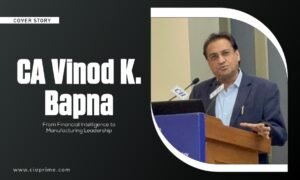
There are leaders who build careers around a function, and there are leaders who gradually expand the meaning of that function.
CA Vinod K. Bapna belongs to the latter category.
With more than three decades of experience across finance, manufacturing, business strategy, and organizational leadership, Bapna has developed a career defined not simply by numbers, but by the ability to understand what those numbers mean for an enterprise.
Today, as Group Chief Financial Officer of Caparo India and CEO of Caparo Maruti Limited, he operates at the intersection of financial discipline and operational leadership. His responsibilities extend across financial planning and analysis, treasury and structured finance, mergers and acquisitions, investor relations, internal audit, taxation, and business support. At Caparo Maruti, his leadership encompasses the wider business ecosystem, bringing together commercial thinking, manufacturing performance, people, quality, customers, and long-term growth.
That combination is what makes his leadership particularly relevant in 2026.
Modern business leadership is no longer about keeping finance, operations, technology, people, and strategy in separate rooms. The strongest organizations are built when these functions understand one another and move toward the same objective.
Bapna’s career reflects precisely that philosophy.
His journey through prominent industrial organizations—including AVTEC, Spark Minda, NTN Manufacturing India, and National Engineering Industries, has given him exposure to businesses where financial decisions are inseparable from manufacturing realities.
At Caparo, that experience has evolved into a broader leadership mandate.
His story is ultimately about turning financial intelligence into business action, and business action into sustainable enterprise value.
The Architect Behind the Numbers
Finance is often viewed through the language of balance sheets, budgets, margins, working capital, and profitability.
But at the highest level of leadership, finance becomes something much larger.
It becomes a way of understanding an organization.
For Bapna, decades of experience in financial management have created an ability to look beyond individual numbers and understand the relationship between capital, people, processes, technology, customers, and growth.
His professional foundation is unusually comprehensive. He is a Chartered Accountant, Cost Accountant, and Company Secretary, having completed these professional qualifications in his first attempts, alongside his Bachelor of Commerce degree from Rajasthan University. Caparo’s leadership profile notes his extensive experience in building and leading finance teams within organizations operating at significant scale and complexity.
But qualifications alone do not explain the trajectory of his career.
The more important element is how he has applied them.
A modern CFO must increasingly understand manufacturing cycles, supply chains, technology, customer expectations, risk, investment decisions, talent, and strategic partnerships. Bapna’s career has placed him directly within this broader environment.
AIBCF’s profile of Bapna emphasizes his experience across financial management, business analysis, management assurance, treasury operations, structured financing, taxation, and business leadership. It also highlights his involvement across manufacturing, engineering, marketing, production, quality control, supply chain, and people-related functions.
That breadth matters.
Because when a financial leader understands the factory floor, the customer, the supply chain, and the boardroom, financial strategy stops being an isolated corporate exercise.
It becomes a business strategy.
When the CFO Thinks Like a Ceo
The evolution of the CFO role has become one of the defining changes in modern corporate leadership.
Today’s CFO is expected to do much more than report what happened yesterday.
The role increasingly requires asking what happens next.
Where should the company invest?
Which capabilities need to be strengthened?
Where can technology create an advantage?
How should capital be deployed?
How can efficiency be improved without compromising quality?
How can a company protect profitability while continuing to innovate?
And, perhaps most importantly, how can growth remain sustainable?
Bapna’s transition between finance leadership and operational leadership provides an interesting answer to these questions.
As Group CFO of Caparo India, he oversees a broad portfolio of financial and strategic functions. As CEO of Caparo Maruti, his perspective extends directly into business execution. Caparo’s leadership profile states that he joined the organization in 2019 and has worked closely with its senior leadership since then.
This dual perspective creates a valuable leadership advantage.
A CEO must understand the economics of decisions.
A CFO must understand the consequences of decisions.
Bapna’s role requires him to do both.
That is why his leadership can be viewed through a larger lens: financial stewardship combined with operational accountability.
It is a combination particularly relevant to India’s manufacturing sector, where competitiveness increasingly depends on cost discipline, quality, technology, speed, resilience, and continuous improvement.
Building Manufacturing Excellence
Manufacturing excellence is not created by one investment, one technology, or one strategy.
It is created through thousands of decisions made consistently over time.
Quality standards must become habits.
Processes must become repeatable.
People must understand the purpose behind the process.
Technology must solve real problems rather than simply become another line item.
And efficiency must never be allowed to destroy customer value.
Bapna’s public commentary reflects this understanding.
Reflecting on the Caparo-Maruti Suzuki ecosystem, he described manufacturing excellence as something built through “discipline, trust, quality, technology” and continuous improvement.
That observation captures an important characteristic of his leadership philosophy.
Technology alone does not create manufacturing excellence.
Neither does cost reduction.
Neither does scale.
Excellence emerges when technology, people, processes, quality, and leadership reinforce one another.
This philosophy is particularly significant within Caparo’s ecosystem.
Caparo India began operations in 1994 through Caparo Maruti Limited, a joint venture with Maruti Suzuki India Limited. Over time, the group expanded into engineering, power, logistics, steel processing, and other specialized businesses. Caparo’s corporate profile describes its operations as spanning multiple business areas and serving major automotive and engineering customers.
The scale of such an ecosystem creates complexity.
And complexity demands leaders who can connect the dots
From Components to Capabilities
The automotive industry is undergoing a profound transformation.
Electrification, automation, connected manufacturing, artificial intelligence, supply-chain localization, sustainability, advanced materials, and changing customer expectations are reshaping the competitive landscape.
For component manufacturers, the question is no longer simply how to produce more.
The question is how to become more capable.
That means developing technology.
Strengthening engineering.
Improving quality.
Building resilient supply chains.
Developing people.
Understanding customers.
And continuously improving productivity.
Bapna’s public remarks on the future of automation demonstrate an awareness of this transition. Speaking about robotics and automation, he has highlighted the opportunity for Haryana and Gurugram to strengthen their role in India’s manufacturing and automation journey.
This perspective is important because it demonstrates a leader willing to look beyond his own organization.
Industrial leadership is ultimately about ecosystems.
One company’s progress depends upon suppliers, customers, technology providers, skilled talent, infrastructure, policymakers, educational institutions, and entrepreneurs.
The leaders who understand this ecosystem perspective will be the ones capable of shaping India’s next industrial chapter.
Bapna’s leadership increasingly reflects that broader outlook.
The Power of Partnerships
One of the most important lessons from Bapna’s leadership journey is that sustainable business growth rarely happens in isolation.
Partnerships matter.
Trust matters.
Long-term relationships matter.
Caparo Maruti’s association with Maruti Suzuki is an example of how industrial ecosystems can evolve over decades.
In a recent reflection following an interaction with Suzuki Motor Corporation President Toshihiro Suzuki, Bapna described great companies as organizations that build ecosystems capable of creating opportunities, capabilities, and better quality of life.
That idea extends well beyond the automotive sector.
The strongest business partnerships are not merely transactional.
They create learning.
They create standards.
They create capability.
They create opportunities for organizations to become better than they were before.
For Indian manufacturing, this ecosystem approach has become increasingly important as the country positions itself as a global manufacturing and supply-chain destination.
The future will favor organizations that can combine global standards with local capabilities.
And leaders who can build trust across those boundaries will play a central role.
The Human Side of Leadership
Behind every financial model is a team.
Behind every manufacturing line is a group of people.
Behind every strategy is a culture capable, or incapable, of executing it.
This is why leadership cannot be reduced to performance metrics.
Bapna’s professional profile repeatedly emphasizes his ability to work with senior management, joint-venture partners, promoters, and teams, while also highlighting mature judgment, discretion, strategic foresight, and a commitment to high-performance teams.
These qualities become particularly important in complex organizations.
A leader may have access to sophisticated technology and extensive financial resources, but execution ultimately depends on people.
People need clarity.
They need trust.
They need accountability.
And they need leaders who can make difficult decisions while keeping the organization aligned around a larger purpose.
This is where Bapna’s finance background becomes an advantage rather than a limitation.
Financial discipline teaches accountability.
Operational leadership teaches execution.
People leadership teaches empathy and alignment.
The combination creates organizational resilience.
The Balance Between Efficiency and Experience
One of the most interesting aspects of Bapna’s recent professional commentary is his observation that efficiency must have limits.
Discussing the airline industry’s approach to optimizing capacity, he noted that “Every optimisation has a limit.” He connected this principle to customer experience, emphasizing that gains visible on a balance sheet can create longer-term consequences when customer comfort, loyalty, or trust are compromised.
The observation is highly relevant to virtually every industry.
Business leaders are constantly asked to improve efficiency.
Reduce costs.
Increase utilization.
Improve margins.
Automate processes.
Do more with less.
But sustainable leadership requires another question:
What should never be sacrificed in the pursuit of efficiency?
Quality.
Trust.
Customer experience.
Employee capability.
Long-term reputation.
These are difficult to capture in a quarterly report, but they are often among an organization’s most valuable assets.
The lesson is simple yet powerful:
Optimization should strengthen an organization, not weaken the foundations on which its future depends.
Leadership With a Longer Horizon
The best leaders do not manage only for the next quarter.
They build for the next decade.
This is especially important in manufacturing, where investments in plants, machinery, technology, engineering capability, talent, and supplier ecosystems often require years before their full potential is realized.
Bapna’s career demonstrates the value of long-term industrial experience.
Before joining Caparo, he held leadership positions across several significant manufacturing organizations, building experience across different operating environments. Caparo describes his professional journey as more than 32 years of experience building and leading finance teams within complex industrial businesses.
That accumulated experience creates perspective.
It allows a leader to distinguish between a temporary challenge and a structural change.
Between a cost and an investment.
Between a short-term gain and long-term value.
Between growth and sustainable growth.
This perspective will become increasingly important as Indian businesses navigate global uncertainty, technological disruption, changing supply chains, and the accelerating shift toward smarter manufacturing.
The Next Generation of Indian Industry
India’s manufacturing opportunity is no longer only about producing at lower cost.
It is about producing with greater intelligence.
The next generation of industrial organizations will need to combine:
Technology with human capability.
Automation with skilled talent.
Financial discipline with innovation.
Global standards with Indian scale.
Efficiency with customer experience.
Growth with sustainability.
Leaders such as Bapna are positioned at the center of this transition because their careers have evolved across multiple dimensions of the enterprise.
His public engagement with industry forums, manufacturing transformation, automation, and leadership discussions also demonstrates a willingness to participate in conversations that extend beyond his immediate corporate responsibilities. Publicly available profiles identify him with industry leadership roles and forums focused on manufacturing and business development.
This broader engagement matters.
Leadership becomes more influential when knowledge is shared.
The future of Indian industry cannot be built by individual companies alone. It requires collaboration between corporations, entrepreneurs, policymakers, educational institutions, technology companies, and the next generation of leaders.
A Leader Who Connects Finance with Purpose
What distinguishes an influential leader is not simply the position on the business card.
It is the ability to influence how people think.
Bapna’s career illustrates a transition from financial expertise toward broader enterprise leadership.
His role today requires him to think about capital, profitability, operations, technology, customers, people, partnerships, and future opportunities simultaneously.
That is a demanding leadership equation.
Yet it is also the kind of leadership modern businesses increasingly require.
The CFO of the future will not simply protect the balance sheet.
The CEO of the future will not simply set the strategy.
Both roles will need to understand how every decision affects the entire enterprise.
Bapna’s professional journey demonstrates that evolution in action.
His story is not about finance versus operations.
It is about finance enabling operations.
Operations creating customer value.
Technology accelerating capability.
People executing strategy.
And leadership connecting everything together.
The Power Icon
Influence is often associated with visibility.
But some of the most influential leaders operate behind the scenes—making decisions, developing systems, strengthening teams, solving complex problems, and preparing organizations for challenges that may not yet be visible.
CA Vinod K. Bapna’s career represents this form of influence.
His professional journey spans more than three decades.
His expertise crosses finance and manufacturing.
His current responsibilities combine group-level financial leadership with CEO accountability.
His perspective extends from enterprise value to industrial capability.
And his public thinking increasingly addresses the larger questions shaping India’s business future.
At a time when companies are being asked to become faster, smarter, more efficient, more sustainable, and more resilient, leadership must evolve accordingly.
The leaders who will define the coming decade will be those who can see beyond their individual functions.
They will understand that a balance sheet is connected to a factory.
A factory is connected to people.
People are connected to culture.
Culture is connected to customers.
Customers are connected to trust.
And trust is ultimately connected to long-term enterprise value.
That is the deeper meaning of modern leadership.
And that is why CA Vinod K. Bapna stands out among The Power Icons 2026.
Looking Ahead
The next chapter of Indian manufacturing is being written now.
It will be shaped by automation, artificial intelligence, advanced engineering, resilient supply chains, new energy systems, digital transformation, and increasingly sophisticated global customers.
But technology will only be one part of the equation.
The decisive factor will remain leadership.
Leaders who can balance ambition with discipline.
Growth with responsibility.
Efficiency with experience.
Technology with people.
And short-term performance with long-term value.
Bapna’s career offers a compelling example of this balance.
From his foundation in professional finance to his leadership across complex industrial businesses, his journey demonstrates how a strong understanding of numbers can evolve into a broader understanding of business.
His philosophy can perhaps be summarized through a simple idea reflected in his recent thoughts on manufacturing:
The journey continues. The standards rise. And the best is yet to come.
For Indian industry, that mindset may be more important than ever.
Because the future will not belong simply to organizations that grow.
It will belong to organizations that continuously improve.
And behind those organizations will be leaders capable of turning experience into insight, insight into action, and action into lasting impact.