
A Water-Tech Visionary – Gregoire de Hemptinne: Shaping the Future of a Sustainable Tomorrow with Shayp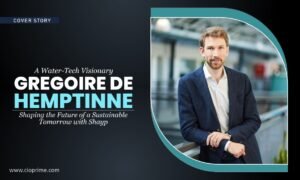
Our life, as precious as it is, has its origin in a more precious element, water, a nectar of our Mother Earth. Water is timeless and priceless. Yet, since it had been available to us in abundance, we stopped caring about it as we should have. Today, with an ever-increasing demand for this exquisite resource, we must re-examine our own misconceived notions and rethink our own mismatched policies when it comes to the demand and supply of water. Luckily, for us, there is one, Gregoire de Hemptinne, recognized as one of the most innovative water tech leaders of our time, who has taken the mantle upon his shoulders. In his mission to bring the critical importance of saving water to the fore, Gregoire, as the Co-founder, established Shayp, a water intelligence company based in Brussels, and as the Chief Executive Officer (CEO), along with his team of experts, is helping building operators detect and eliminate water inefficiencies using IoT sensors and AI analytics before they become costly problems or environmental liabilities.
A Non-linear Journey
Earlier, when Gregoire began his professional journey, his path wasn’t linear. He spent years as a software developer and architect, then pursued an MBA at IESE, and somewhere along the way, the question shifted from ‘what can he build?’ to ‘what actually matters to build?’
Gregoire recalls that water kept coming up as one of the most underestimated crises of our time: invisible in infrastructure, underpriced as a resource, and massively wasted every single day. “That mismatch between urgency, the scale of the problem, and awareness is what drew me in, and what still drives me.”
Solving the Most Underestimated Crises of Our Times
This urgent yet overlooked crisis sparked Gregoire’s curiosity for disruptive water tech and how it has shaped his approach to environmental resilience. He explains further: water is one of those domains where the data gap is staggering. Buildings consume enormous volumes of water, yet most facility managers have almost no real-time visibility into what’s happening inside their pipes. That gap between how much water flows in and how much is actually needed is where Shayp lives. His curiosity was also sparked by realizing that the tools to solve this already existed: sensors, connectivity, and machine learning. The disruption wasn’t technological. It was about applying known tools to a space that had been ignored and finding business models that could activate several stakeholders at the same time. Resilience, to Gregoire, isn’t about grand solutions; it’s about making the invisible visible so that organizations can act before damage accumulates.
Creative Thinking That Drives Innovation
At Shayp, Gregoire ensures that creative thinking and design-thinking techniques drive innovation. He shares, “Design thinking taught me to start with the multiple stakeholders’ pain before reaching for a technical solution.” In water management, the real pain isn’t the leak, it’s the bill that arrives three months later, the tenant complaint, the insurance claim. So they designed Shayp around early detection and actionable alerts, not just data collection. They constantly ask: ‘Would a facility manager actually act on this?’ That filter shapes every product decision. “Creatively, it also means we don’t try to replace the plumber or the engineer; we make their job easier, faster, and more precise.” Good design is often about radical simplification, not added complexity. “We’re driven by the motto of ‘simplicity is the ultimate sophistication,’ from Leonardo Da Vinci.”
Building the Winning Solutions
As a customer-oriented leader, evaluating the real value of a tech solution against its workload is something Gregoire cares deeply about. A solution that requires significant behavioral change or operational burden will fail, no matter how clever it is. “At Shayp, we measure ourselves against a simple benchmark: does installing our system create more work than it saves? If the answer is ever yes, we’ve failed. Our target is that within weeks of deployment, a building manager gets their first alert, acts on it, saves money, and creates a story that they will remember.” That first tangible win is what drives adoption and renewal. ROI has to be felt quickly, not just calculated on a spreadsheet. “We obsess over time-to-value as much as we obsess over the technology itself.”
Learning from Different Methodologies
Also, the modern, lean, agile, and flexible methodologies helped Gregoire and his team adapt to evolving market needs. He shares that while moving through the roles of developer, architect, CTO, COO, and now CEO, he has seen how methodologies either liberate or constrain teams depending on how they’re applied. Lean taught him to eliminate waste relentlessly: in code, in process, in features nobody uses. Agile gave him the discipline to ship imperfect things fast and improve them with real feedback. As an entrepreneur, this matters enormously. The market doesn’t wait for you to be ready. “When we expand across nine European countries, we have to localize, adapt to different regulatory environments, and respond to customer needs that differ significantly by geography.” The teams that thrive are the ones that can pivot without losing direction.
Standing for People-Centered Processes
Gregoire further informs that he fosters debates and people-centered processes in innovative teams. “I believe that silence in a meeting is usually a failure of leadership, not a sign of agreement.” Strong teams need psychological safety to disagree, challenge assumptions, and bring inconvenient truths to the table. He tries to create that by modeling it, by being the first to say ‘he was wrong’ or ‘he doesn’t know.’ In a small team like Shayp, the cost of groupthink is too high. “We’re making decisions that affect how we grow, who we hire, and which markets we enter.” Those decisions need honest friction. “I’d rather have a difficult conversation now than an expensive mistake later.” People-centered leadership doesn’t mean being soft; it means treating your team as your most strategic asset. “We apply the one-way and two-way door methodology to weigh out the strategic decisions and make sure not to rush into important decisions.”
Experiences that Taught Him the Key Lessons
Back in the days, his seven years of working in the information technology sector and his MBA gave Gregoire key lessons in forming Shayp. He reflects, “The IT years gave me pattern recognition, the ability to see complex systems and identify where they break down. The MBA gave me language for what I was already intuiting: market dynamics, unit economics, organizational design. But honestly, the most important lesson from both was humility. I’ve seen brilliant engineers build things nobody wanted, and I’ve seen MBAs project-manage their way to irrelevance.” What works is combining technical credibility with commercial clarity: Understanding what you’re building, for whom, and why they’ll pay for it. The European startup ecosystem also pushed him to think about scaling across fragmented markets from day one, “Which shaped how we built Shayp’s go-to-market strategy.”
Furthermore, Gregoire’s experiences as a former military and mountain guide influenced his leadership style. Both experiences taught him to make decisions under uncertainty, with incomplete information, when the stakes are real. In the mountains, conditions change fast, and you don’t get to pause and deliberate indefinitely: you read the situation, you commit, and you adjust. The military gave him an understanding of the chain of command, but more importantly, of mission clarity. When everyone understands the objective, they can improvise intelligently toward it. He brings that into Shayp: “I’d rather have a team that understands our ‘why’ deeply than one that follows instructions blindly. And the respect for nature that guiding instilled in me is, at some level, the entire reason I decided to work in water-tech.”
A Personal Drive
Also, there is one personal purpose that drove Gregoire to found Shayp. He is a father. He says that changes your relationship with the future. When he thinks about the water stress projections for the next twenty years: droughts, infrastructure strain, urban scarcity, he doesn’t think about market opportunity first. Rather, he thinks about what world his son will inherit. “Shayp exists because I believe that one of the most powerful things we can do right now is stop wasting what we already have.” Buildings in Europe waste an estimated 20–30% of their water to leaks and inefficiencies. That’s not a technical problem, it’s an attention problem. “We have the tools. We just need to deploy them at scale, and that’s exactly what we’re doing.”
Riding Three Major Water-Tech Trends
Looking ahead, Gregoire envisions that Shayp is positioned to lead three emerging water tech trends. First, the integration of water data into ESG reporting — water is becoming a material risk for corporate balance sheets, not just an operational cost. Second, the convergence of water and energy efficiency, as buildings pursue holistic sustainability targets. Third, the rise of predictive infrastructure management, where AI moves from detection to prevention and planning. Shayp sits at the intersection of all three. “We’ve moved beyond leak detection, and we’re becoming the operating system for water management in commercial and industrial real estate, giving building owners and sustainability teams the intelligence they need to act proactively. With partnerships across Google, Microsoft, and Amazon’s European portfolios, we’re well-positioned to lead this next chapter.”
Toggling Between the Ropes
When asked about how he balances technical expertise with business acumen to optimize ROI for customers, Gregoire replies, “The honest answer is that I’ve had to work hard at both, and learn to toggle between them depending on the context. With engineers, I can go deep into data architecture and sensor calibration. With CEOs, CFOs, and asset managers, I translate that into avoided costs, insurance risk reduction, and ESG compliance.” The bridge between the two is a clear value narrative: one that doesn’t oversimplify the technology but doesn’t hide it behind jargon either. “Our best commercial conversations happen when we walk in with real data from comparable buildings and show what changed after Shayp was deployed.” Numbers do the selling; relationships do the closing.
Shifting Behaviour for the Better
Finally, Gregoire wishes to build a legacy on the foundation of water conservation. If Shayp can demonstrate at scale that intelligence applied to water infrastructure changes how buildings are managed across Europe, “that’s a legacy I’d be proud of.” Not because of the company, but because of what it proves: that a small team with clarity of purpose can shift behavior in an industry that moves slowly. Building a company is not only about building technology, but also about building ecosystems with multiple stakeholders (users, datacenters, utilities, insurance).
A Simple Message
In the end, Gregoire’s advice to aspiring innovators in this space is simple: don’t underestimate the unsexy parts of the problem. The technology is often the easiest piece. The hard parts are trust, change management, and patience. “Water isn’t glamorous. But it’s essential. And essential problems, solved well, are the ones that endure.