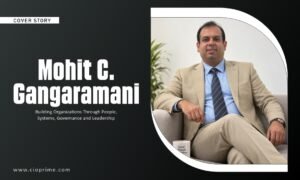
Mohit C. Gangaramani: Building Organizations Through People, Systems, Governance and Leadership
I see HR not as a support function operating alongside the business, but as one of the systems through which the business is built.
Over more than two decades, I have worked across recruitment, workforce mobilisation, HR operations, payroll, employee relations, administration, organization design, technology, governance and leadership. My career has taken me across the UAE, Saudi Arabia, Qatar, and India, and across businesses including construction, real estate, manufacturing, hospitality, and investment.
That journey has shaped how I see the role of a CHRO.
At this level, the question is no longer simply whether HR processes are working. The question is whether the organization has the people, leadership, structure, culture and operating discipline necessary to execute its strategy.
Building Organizations, Not Only HR Functions
Much of my career has involved joining organizations during periods of growth, transformation or complexity.
I enjoy those environments because they require more than maintaining existing systems. They require creating something that can support the business’s next direction.
My instinct when an organization faces pressure is not immediately to add more people. I first ask whether the process, structure or decision framework itself needs to be redesigned.
That thinking has led me to build and restructure HR functions, separate recruitment from employee deployment, introduce digital recruitment and HR systems, strengthen payroll and attendance controls, establish job structures and authority frameworks, and build teams capable of supporting significantly larger organizations.
My objective is simple: Growth should create capability, not chaos.
HR Must Understand the Business
One of the earliest lessons of my career came from recruitment.
A vacancy was never simply an HR vacancy.
If the right engineer did not arrive, a project could be delayed. If mobilisation took too long, operations were affected. If manpower costs were not understood, budgets were affected. If payroll was wrong, employee trust was affected.
That taught me to connect people decisions directly to business outcomes.
Today, when I discuss workforce plans with management, I am thinking simultaneously about organization structure, productivity, cost, capability, project requirements, succession, employee experience and risk.
That is where I believe a CHRO creates value, at the intersection of people and business execution.
My Leadership Philosophy
Earlier in my career, I considered myself successful when I could solve difficult problems personally.
My definition of leadership has changed.
At the executive level, my responsibility is to create people who can solve those problems without continuously depending on me.
I therefore believe strongly in delegation with accountability.
People need clarity regarding what is expected from them, authority to take decisions, access to information and the confidence that their leader will support them.
I give my team space to operate. I do not want everything coming back to my desk.
But leadership also means being available.
If the team reaches a situation beyond its experience, I should still have enough understanding of the function to roll up my sleeves, get into the detail with them and help resolve it.
For me, empowerment does not mean absence.
It means building capability while remaining accessible.
People and Performance Are Not Opposites
I am strongly process- and governance-oriented, but I don’t believe discipline and empathy compete with each other.
In fact, organizations need both.
Too much compassion without accountability eventually creates inconsistency.
Too much discipline without humanity eventually creates fear.
The responsibility of leadership is to find the balance.
Employees experience culture through very ordinary moments: whether salaries are correct, whether managers treat people fairly, whether communication is transparent, whether accommodation and workplaces are appropriate, whether families feel secure and whether the company stands with its people when circumstances become difficult.
For me, engagement is therefore much bigger than events.
It is about trust.
Work, Family and Sustainable Performance
I also believe executive performance has to be sustainable.
Senior roles will always contain periods when the business demands extraordinary attention. I accept that responsibility. There are situations when work cannot simply stop because the clock has reached a particular hour.
But I don’t believe leadership should become an excuse for permanently neglecting everything outside work.
Family gives me perspective and reminds me that an executive title is only one part of who I am.
Sport is another important part of my life. Padel, in particular, helps me disconnect mentally, remain physically active and reset. Interestingly, it also reinforces many things I value professionally: anticipation, adaptability, competitiveness, partnership and knowing when to attack and when to be patient.
So I don’t look at work-life balance as an exact 50:50 mathematical equation.
I look at it as work-life sustainability.
There will be periods when work requires more. There will also be moments when family must take priority.
The discipline is making sure neither side is continuously sacrificed.
How I Deal With Challenges
I have learned that senior leadership is rarely about choosing between a good option and a bad option.
Usually, the difficult decisions are between two imperfect alternatives.
When I encounter a major challenge, I try to separate the issue into four questions:
What is actually happening?
What is the business impact?
What is the human impact?
What decision will remain defensible six months from now?
I then rely on facts, involve the right stakeholders, understand the risks and make the decision.
Once the decision is made, I believe communication becomes extremely important.
People can handle difficult decisions better than they can handle uncertainty, inconsistency or silence.
I also don’t believe leaders need to pretend they always have the answer.
If I don’t know something, I will say so, understand it quickly, consult the people who know more than I do and then decide.
That does not weaken leadership.
It strengthens decision quality.
Resilience
My resilience comes partly from my early life.
I learned relatively young that circumstances will not always arrive according to plan and that responsibility sometimes comes before readiness.
That experience gave me a strong sense of discipline, self-reliance and responsibility.
Professionally, it has helped me remain calm during organizational change, difficult workforce situations, rapid growth and situations where systems were incomplete.
I tend not to become overwhelmed by the size of the problem.
I break it down.
What needs attention immediately?
What can wait?
What requires a process?
What requires a person?
What requires a decision from leadership?
Once a complex problem becomes structured, it becomes manageable.
Technology and the Future of HR
I see technology, including AI, as an accelerator rather than a replacement for leadership judgment.
Technology should remove repetitive work, improve information quality and allow teams to spend more time solving problems.
But leaders must still understand the process underneath the technology.
We also need strong governance regarding confidentiality, approved tools, data use, validation and accountability.
My expectation from HR professionals will therefore continue to increase.
Technology may make the work faster.
But human judgment, empathy, commercial understanding and leadership will become even more important.
The CHRO I Aspire to Be
I do not measure success by how dependent an organization becomes on me.
I measure it by the opposite.
Is the organization stronger?
Are decisions happening at the right levels?
Are systems functioning consistently?
Are employees treated fairly?
Are leaders growing?
Can the organization continue to perform when I am not in the room?
That is the kind of institution I want to build.
And that is ultimately how I see the responsibility of a CHRO:
Build the people, systems, leadership and culture that enable the business to succeed, and build them strongly enough that the organization can eventually succeed without depending on any one individual.