
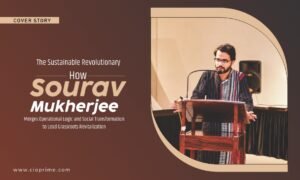
The Sustainable Revolutionary: How Sourav Mukherjee Merges Operational Logic and Social Transformation to Lead Grassroots Revitalization
A real innovator is one who treats social and community growth not something as a charity project that can be done passively. Instead, true innovative leaders, especially in the social developmental sector, like Sourav Mukherjee, are those who see holistic progress as a well-structured organic ecosystem. In it, the strategic planning is built in such a way that it continuously and actively empowers human lives. As the visionary Founder and Director of the Kolkata Society for Cultural Heritage (KSCH), Sourav constantly implements this philosophy into pragmatic action across India’s socio-developmental sector. Within the competitive technology and corporate sectors, is where Sourav originally began his professional journey. Standard aspirations centered around career advancement, financial stability, and technical mastery drove him at that time. This early corporate chapter exposed him excellently to some crucial topics. Like highly structured organizational systems. Complex project management, long-term strategic planning. Stakeholder engagement. And performance-driven metrics. These intense corporate environments taught him professional discipline’s foundational value. It further inculcated in him an accountability that was real, along with operational efficiency and scalable innovation. He mastered the mechanics. Of how global organizations operate. How teams remain motivated under pressure. And how lasting commercial success depends on a clear corporate vision paired with precise execution.
“However, while the corporate world offered valuable learning opportunities, I gradually realized that I wanted my work to have a more direct and visible impact on people’s lives. During various interactions with communities across rural and underserved regions, I became increasingly aware of the significant social and economic challenges faced by marginalized populations. I encountered women struggling to access sustainable livelihoods, young people lacking opportunities for skill development, communities vulnerable to environmental degradation, and traditional artisans whose cultural heritage was slowly disappearing due to changing economic realities.”
These experiences became turning points in Sourav’s life. They encouraged him to question the conventional definition of success and inspired him to explore ways through which professional skills could be used to create meaningful social transformation. This transition was neither sudden nor easy. Moving from a relatively predictable professional environment into the complex world of development work required a complete shift in mindset. He had to learn to work with uncertainty, adapt to diverse social realities, and appreciate that community development is often a long-term process that demands patience and trust-building.
The Organizational Foundation
One of the most significant milestones in Sourav’s journey was the establishment and growth of KSCH, the Kolkata Society for Cultural Heritage. The organization was founded with the belief that sustainable development must be rooted in local knowledge, community participation, and cultural identity. Over time, KSCH expanded its focus to include women’s empowerment, livelihood generation, environmental sustainability, renewable energy, skill development, and climate resilience.
Building and leading an organization from the ground up taught him lessons that no classroom or management program could have provided. He learned that leadership requires resilience, especially during periods of uncertainty. In the early years, resources were limited, partnerships had to be developed carefully, and every project required persistent effort. There were moments when challenges seemed overwhelming, but those experiences reinforced his belief that genuine leadership involves staying committed to a vision even when immediate results are not visible.
The Inclusive Collective
Another defining influence on his leadership philosophy has been his work with women’s empowerment initiatives. Across many communities, he has witnessed remarkable examples of determination, creativity, and resilience among women who, despite facing significant barriers, have transformed their lives through entrepreneurship and collective action. Working closely with self-help groups, artisan collectives, and women-led enterprises taught him that leadership is not about directing people; it is about enabling people to discover and develop their own potential.
These experiences strengthened his conviction that inclusive leadership produces more sustainable outcomes. When people feel ownership over a process, they become active contributors rather than passive beneficiaries. As a result, he has always tried to create participatory environments where stakeholders are involved in decision-making, planning, and implementation. He believes that the most effective solutions emerge when communities are treated as partners rather than recipients of assistance.
The Interconnected Landscape
Environmental conservation has also played a major role in shaping his worldview. His involvement in projects related to mangrove restoration, climate adaptation, and sustainable natural resource management highlighted the interconnectedness of environmental and social issues. Working in ecologically sensitive regions such as the Sundarbans demonstrated that development cannot be separated from environmental sustainability. Communities depend on natural ecosystems for their livelihoods, and environmental degradation directly affects economic security and social well-being.
These experiences taught him the importance of long-term thinking. Leadership often requires balancing immediate needs with future sustainability. It is tempting to focus only on short-term outcomes, but meaningful change requires decisions that consider future generations. This principle continues to guide his approach to project design, organizational strategy, and partnership development.
The Synergy Advantage
Partnership building has been another critical aspect of his professional journey. Throughout Sourav’s career, he has had the opportunity to collaborate with government agencies, corporate organizations, academic institutions, international partners, civil society groups, and grassroots communities. These collaborations reinforced an important lesson: no single organization can solve complex social challenges alone. Sustainable impact requires collective action and shared responsibility.
As a leader, he has therefore emphasized collaboration over competition. He believes that successful partnerships are built on trust, transparency, mutual respect, and clearly defined objectives. By bringing together diverse stakeholders with complementary strengths, it becomes possible to create solutions that are more comprehensive and effective than those developed in isolation.
The Adaptive Framework
A particularly important influence on his leadership philosophy has been the concept of continuous learning. Development work constantly exposes one to new realities, emerging challenges, and evolving community needs. Every project, whether successful or unsuccessful, provides valuable lessons. He has always encouraged his teams to embrace learning, experimentation, and adaptation. Mistakes should not be viewed as failures but as opportunities to improve systems and approaches.
This learning-oriented mindset became especially important during periods of crisis and rapid change. Whether dealing with natural disasters, economic disruptions, public health emergencies, or climate-related challenges, flexibility and innovation have proven essential. Effective leadership requires the ability to respond quickly while remaining grounded in core values and long-term objectives.
The Humility Practice
Another key principle that has shaped his leadership philosophy is empathy. Technical expertise, strategic planning, and management skills are important, but leadership ultimately involves understanding people. Empathy allows leaders to appreciate different perspectives, build trust, and create environments where individuals feel valued and respected. Many of the most meaningful lessons he learned came not from formal training but from listening to community members, field workers, artisans, farmers, and entrepreneurs share their experiences.
Over the years, he has come to view leadership as a service rather than a position of authority. A leader’s responsibility is to create opportunities for others, remove barriers, facilitate growth, and support collective progress. This perspective has influenced how he engages with teams, partners, and communities. He believes that leadership should empower others to become leaders themselves.
Integrity has also remained a fundamental component of his professional philosophy. In the development sector, trust is one of the most valuable assets an organization can possess. Communities, donors, partners, and stakeholders place their confidence in organizations that demonstrate transparency, accountability, and ethical conduct. Maintaining that trust requires consistent commitment to honesty and responsible stewardship of resources.
The Harmonized Philosophy
Today, when he reflects on his journey, Sourav recognizes that each experience has contributed to the development of his leadership philosophy. The corporate sector taught him discipline and strategic thinking. Community engagement taught him empathy and humility. Environmental work taught him sustainability and long-term vision. Women’s empowerment initiatives taught him the transformative power of inclusion. Organizational leadership taught him resilience, adaptability, and collaboration.
Together, these experiences have shaped a philosophy centered on purpose-driven leadership, community participation, continuous learning, ethical conduct, sustainability, and empowerment. He believes that lasting impact is achieved not through individual accomplishments but through collective efforts that enable people and communities to realize their full potential. His journey continues to reinforce the belief that leadership is ultimately about creating positive change while inspiring others to become active participants in building a more equitable, sustainable, and inclusive future.
The Analytical Shift
Sourav’s decision to pursue a career in technology and innovation was driven by a combination of curiosity, problem-solving instinct, and a desire to create meaningful change. From an early stage in his life, he was fascinated by the way technology could simplify complex processes, connect people across distances, and create opportunities that were previously unimaginable. What attracted him most was not the technology itself, but its potential to transform lives and solve real-world challenges. Over the years, that initial interest evolved into a broader vision that connected technology with social development, sustainability, entrepreneurship, and community empowerment.
When he first entered the professional world, technology was rapidly transforming industries across the globe. Organizations were increasingly relying on digital systems, data-driven decision-making, and innovative solutions to improve efficiency and competitiveness. Being part of this environment was exciting because it exposed him to the power of innovation in action. He saw how technology could streamline operations, improve communication, increase productivity, and enable organizations to achieve objectives that would have been difficult through traditional methods alone. One of the most important lessons he learned during his early professional years was that technology is fundamentally a tool. Its value is determined not by its complexity but by the problems it solves and the people it serves. This understanding shaped his approach from the very beginning. Rather than focusing solely on technical sophistication, he became interested in understanding how innovation could generate tangible benefits for individuals, organizations, and communities.
Working in the technology sector gave him opportunities to engage with diverse projects, teams, and stakeholders. He learned the importance of analytical thinking, project management, process optimization, and strategic planning. The technology environment encouraged continuous learning because new tools, platforms, and methodologies emerged constantly. This culture of innovation taught him that adaptability is one of the most valuable professional skills. The willingness to learn, experiment, and evolve became a defining aspect of his professional mindset. As his career progressed, he began to recognize that some of the most pressing challenges facing society existed outside the corporate environment. During interactions with rural communities, grassroots organizations, and development practitioners, he observed significant gaps in access to resources, information, markets, education, and livelihood opportunities. These experiences profoundly influenced his thinking because they revealed a stark contrast between technological advancement and social reality.
The Inclusive Pivot
In many underserved communities, people possessed tremendous talent, determination, and traditional knowledge, yet they lacked access to systems that could help them unlock their full potential. Women entrepreneurs struggled to access markets. Artisans found it difficult to reach customers beyond their local regions. Farmers faced challenges in obtaining information that could improve productivity. Young people often lacked access to skill development opportunities that could enhance their employability. These observations led him to ask an important question: how can technology and innovation be used to bridge these gaps? This question gradually transformed his vision. Instead of viewing technology primarily as a driver of business efficiency, he began to see it as an enabler of inclusive development. He realized that innovation could play a crucial role in addressing social and environmental challenges if it was designed with people at the center. This shift in perspective eventually influenced many of the initiatives he became involved with through community development and organizational leadership.
One of the key factors that inspired this evolution was his growing engagement with grassroots communities. Spending time in villages, interacting with self-help groups, and working alongside community leaders provided insights that no technical training could offer. These experiences taught him that innovation does not always require advanced technology. Sometimes the most impactful innovations are simple, practical, and closely aligned with local realities. For example, introducing digital tools for market access can significantly improve income opportunities for rural artisans. Renewable energy solutions can enhance the quality of life in remote areas while reducing environmental impact. Digital platforms can support skill development, knowledge sharing, and entrepreneurship. In each of these cases, technology serves as a catalyst that enables communities to achieve outcomes that might otherwise remain out of reach.
His work with women’s empowerment initiatives further strengthened this perspective. Across numerous projects, he witnessed how access to information, communication technologies, and digital platforms could increase economic participation and independence among women. Many women entrepreneurs demonstrated remarkable creativity and resilience when provided with appropriate tools and opportunities. These experiences reinforced his belief that technology should be inclusive and accessible rather than limited to a privileged segment of society. Another significant influence on the evolution of his vision was environmental sustainability. As he became involved in projects related to climate resilience, renewable energy, and ecosystem restoration, he gained a deeper appreciation for the role innovation can play in addressing environmental challenges. The world faces increasingly complex issues such as climate change, resource depletion, biodiversity loss, and environmental degradation. Traditional approaches alone are often insufficient to address these challenges at the required scale.
The Sustainable Platform
Innovation offers opportunities to develop more sustainable solutions. Whether through renewable energy systems, climate-smart agriculture, environmental monitoring technologies, or sustainable production methods, technology can contribute significantly to environmental protection and resilience. However, he also learned that technological solutions must be implemented responsibly. Innovation should complement ecological principles rather than undermine them. The establishment and growth of KSCH provided an important platform for integrating these ideas into practice. Through various projects, they sought to combine technology, innovation, community participation, and sustainability to create meaningful impact. The objective was never simply to introduce new technologies but to ensure that innovations addressed real needs and generated lasting benefits. One of the most valuable lessons from this journey has been the importance of human-centered innovation. Too often, technology initiatives fail because they focus on the technology itself rather than the people who will use it. Effective innovation begins with understanding challenges from the perspective of those experiencing them. It requires listening, collaboration, and empathy. Solutions become more effective when communities participate actively in their design and implementation.
This principle has shaped how he approaches leadership and project development. Whenever evaluating new technologies or innovative approaches, he asks several questions: Does this solve a genuine problem? Is it accessible to the intended users? Can it be sustained over time? Does it strengthen local capacity rather than create dependency? These considerations help ensure that innovation contributes to long-term development rather than temporary intervention. Over the years, digital transformation has accelerated dramatically. Advances in artificial intelligence, data analytics, mobile technology, cloud computing, and connectivity have created opportunities that were difficult to imagine earlier in his career. While these developments are exciting, they also present important responsibilities. Technology can generate tremendous benefits, but it can also widen inequalities if access remains uneven. Therefore, ensuring that innovation contributes to inclusion and equity has become an increasingly important part of his vision.
He believes the future of technology lies not only in technical advancement but also in ethical and responsible application. Innovation should enhance human well-being, strengthen communities, protect the environment, and create opportunities for those who have traditionally been excluded from economic growth. This perspective has become central to his understanding of what meaningful technological progress should look like. Another aspect of his evolving vision involves collaboration. Complex challenges rarely have simple solutions, and no single organization possesses all the expertise required to address them effectively. Technology and innovation achieve their greatest impact when governments, private sector organizations, academic institutions, civil society groups, and local communities work together. Building partnerships that combine diverse perspectives and capabilities has therefore become an important element of his professional approach. Continuous learning has also remained central to his journey. The pace of technological change means that knowledge quickly becomes outdated. Maintaining relevance requires openness to new ideas, emerging trends, and evolving methodologies. He has always encouraged teams and collaborators to embrace experimentation and remain curious. Innovation flourishes in environments where learning is valued, and failure is viewed as an opportunity for improvement rather than a reason for discouragement.
The Broader Paradigm
Today, his vision for technology and innovation is far broader than when he began his career. What started as an interest in technological advancement has evolved into a commitment to leveraging innovation for social impact, environmental sustainability, and inclusive development. He no longer sees technology as an isolated field but as a powerful enabler that can support progress across multiple dimensions of society. When he reflects on this evolution, he realizes that the most important insight he has gained is that technology is most meaningful when it serves people. Innovation should not be measured solely by technical sophistication or commercial success. Its true value lies in its ability to improve lives, expand opportunities, strengthen communities, and contribute to a more equitable and sustainable future.
This belief continues to guide his work today. Whether engaging with community development initiatives, environmental projects, women’s empowerment programs, or organizational leadership responsibilities, he remains committed to exploring how technology and innovation can be harnessed to create positive and lasting change. The tools may evolve, the challenges may change, and new opportunities will undoubtedly emerge, but the underlying purpose remains the same: using innovation as a force for human progress, inclusion, and sustainable development.
The Integrated Progressive Vision
As Sourav looks toward the future, his vision is shaped by a simple but powerful belief: meaningful progress occurs when technology, sustainability, innovation, and human development come together to create lasting value for society. Throughout his professional journey, he has had the opportunity to work across technology, organizational leadership, environmental sustainability, community development, livelihood enhancement, and social impact initiatives. These experiences have reinforced his conviction that the future belongs to organizations and leaders who can balance economic growth with social responsibility, technological advancement with human values, and innovation with sustainability. My vision for the future is not limited to achieving specific organizational goals or professional milestones. Rather, it is centered on contributing to a broader ecosystem where people are empowered, communities are resilient, technology is used responsibly, and development is both inclusive and sustainable. He believes that leadership today requires us to think beyond immediate objectives and consider the long-term impact of our actions on future generations.
One of the key elements of his vision is to continue building initiatives that create sustainable livelihoods and economic opportunities, particularly for communities that have traditionally faced barriers to growth and development. Over the years, he has witnessed the transformative impact that skill development, entrepreneurship support, market access, and community engagement can have on individuals and families. Economic empowerment is not simply about increasing income; it is about creating dignity, confidence, independence, and long-term resilience. Looking ahead, he would like to see these efforts expanded in scale and impact. He is particularly excited about the possibility of integrating technology-driven solutions into livelihood development programs, enabling communities to access new markets, digital tools, financial services, and knowledge resources. The combination of local skills and global connectivity has the potential to unlock opportunities that were unimaginable just a decade ago.
The Inclusive Technology Paradigm
Another important aspect of his vision involves strengthening the role of technology as a force for positive transformation. “We are entering an era where Artificial Intelligence, automation, advanced analytics, digital platforms, and emerging technologies will influence nearly every aspect of society.” While these technologies offer extraordinary opportunities, they also present significant responsibilities. He envisions a future where technology is used not only to improve efficiency and productivity but also to address social, environmental, and developmental challenges. Whether through smarter resource management, improved education systems, enhanced healthcare access, sustainable agriculture, environmental monitoring, or community empowerment, technology can become a powerful enabler of progress. One milestone he is particularly excited about is helping organizations and communities harness emerging technologies in practical and meaningful ways. Technology should not be viewed as something reserved for large corporations or urban centers. Rural communities, small enterprises, women entrepreneurs, youth groups, and grassroots organizations should also have access to the benefits of digital innovation. Bridging this gap and promoting digital inclusion will be an important priority for the future.
Sustainability remains another central component of his long-term vision. Climate change, environmental degradation, biodiversity loss, and resource scarcity are among the defining challenges of our time. These issues require collaborative action across governments, businesses, civil society organizations, and communities. In the years ahead, he hopes to contribute more actively to initiatives that promote environmental stewardship and sustainable development. He is particularly interested in projects that combine ecological conservation with livelihood generation because they address both environmental and socioeconomic needs simultaneously. Sustainable solutions are often most successful when they create value for both people and the planet. One milestone he looks forward to is supporting the development of scalable models that demonstrate how environmental sustainability and economic development can reinforce one another. Too often, these objectives are viewed as competing priorities. In reality, long-term prosperity depends on maintaining healthy ecosystems and resilient communities. Demonstrating this connection through practical initiatives is something he finds both meaningful and exciting.
The Empowered Collective Future
Another important element of Sourav’s future vision is the advancement of women’s empowerment and inclusive development. Throughout his experiences working with women-led livelihood programs and community initiatives, he has seen firsthand how empowering women creates positive ripple effects throughout families and communities. When women gain access to skills, resources, opportunities, and decision-making roles, the benefits extend far beyond individual participants. Looking forward, he hopes to support programs that expand economic opportunities for women, strengthen entrepreneurial capabilities, and enhance access to markets and technology. One milestone he would be proud to achieve is helping create sustainable ecosystems where women are not only participants but also leaders, innovators, and drivers of economic growth. Leadership development is another area that he considers extremely important for the future. Every generation faces unique challenges and opportunities. The leaders of tomorrow will operate in environments characterized by rapid technological change, increasing complexity, and evolving societal expectations. Preparing future leaders, therefore, requires more than technical training. It requires developing critical thinking, ethical judgment, adaptability, emotional intelligence, and a commitment to lifelong learning.
One of his aspirations is to contribute to the development of future leaders through mentorship, capacity building, knowledge sharing, and collaborative learning initiatives. He believes that one of the most meaningful achievements any leader can accomplish is helping others discover and realize their potential. If future leaders are able to build upon the experiences and lessons of previous generations while creating their own innovative approaches, society as a whole benefits. From an organizational perspective, he is excited about the continued evolution of data-driven decision-making and intelligent systems. Organizations today generate vast amounts of information, yet many still struggle to convert data into actionable insights. Emerging technologies offer opportunities to improve planning, performance measurement, risk management, and stakeholder engagement. He envisions a future where organizations become more adaptive, transparent, and evidence-based in their decision-making processes. One milestone he would like to achieve is helping build systems that enable organizations to use data more effectively while maintaining strong ethical standards and human-centered values. Technology should support better decisions, but it should never replace thoughtful leadership and sound judgment.
The Systemic Network Impact
Another area of interest is fostering stronger partnerships and collaborative networks. The challenges facing society today are too complex for any single organization to address independently. Climate resilience, digital inclusion, sustainable livelihoods, education, healthcare access, and economic development all require collective action. In the future, he hopes to contribute to building partnerships that bring together governments, private-sector organizations, academic institutions, nonprofit entities, and communities. Collaboration has the potential to accelerate innovation, expand resources, and create solutions that achieve broader and more sustainable impact. One milestone he would find particularly rewarding is helping establish long-term partnerships that continue creating value well beyond individual projects or funding cycles. He is also excited about the growing emphasis on purpose-driven organizations. Increasingly, stakeholders expect organizations to contribute positively to society rather than focusing solely on financial performance. This shift creates opportunities for leaders to redefine success in more holistic terms. His vision is to support organizational models that integrate profitability, sustainability, innovation, and social impact. The future will favor organizations that can demonstrate not only economic value but also meaningful contributions to communities and the environment. Helping organizations navigate this transformation is an area where he hopes to continue making meaningful contributions.
On a personal level, he remains committed to continuous learning and growth. One of the most valuable lessons Sourav has learned throughout his career is that leadership is a journey rather than a destination. Every experience provides new insights, challenges existing assumptions, and creates opportunities for development. As technology, society, and industries continue to evolve, he looks forward to learning from new experiences, engaging with diverse perspectives, and exploring emerging opportunities. Curiosity has always been one of the driving forces behind his professional journey, and he hopes to maintain that mindset throughout the years ahead. If he were to identify a broader milestone that excites him most, it would be the opportunity to help create lasting systems of impact rather than isolated successes. Individual projects, achievements, and initiatives are important, but sustainable progress occurs when systems are established that continue generating positive outcomes over time. Whether through technology adoption, community empowerment, environmental sustainability, leadership development, or organizational transformation, his goal is to contribute to systems that remain effective and relevant long after their initial implementation.
Ultimately, his vision for the future is rooted in optimism. Despite the challenges facing our world, he believes we are living in a period of extraordinary opportunity. Advances in technology, increasing awareness of sustainability, growing emphasis on inclusion, and expanding global connectivity all create possibilities that previous generations could scarcely imagine. The future will undoubtedly bring uncertainty and disruption, but it will also bring innovation, collaboration, and new opportunities to create positive change. He is excited about the prospect of contributing to that future by helping organizations become more resilient, empowering communities to achieve greater prosperity, supporting sustainable development, advancing responsible technology adoption, and developing leaders who will continue driving progress for years to come. If he were to summarize his vision in a single statement, it would be this: he aspires to contribute to a future where technology serves humanity, economic growth supports sustainability, leadership empowers people, and development creates opportunities that are inclusive, resilient, and lasting. The milestones he is most excited to achieve are those that help turn this vision into reality—one initiative, one partnership, one community, and one leader at a time.