
The Business of Engineering: Engr. (Dr.) Emmanuel Audu-Ohwavborua’s Socio-Technical Framework for Infrastructure Synchronization, Asset Resilience, and Cognitive Utility Transformation 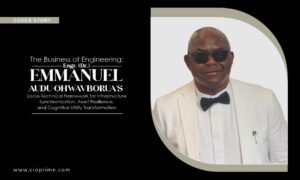
Very few leaders know how to balance complex engineering operations and regional infrastructure development. Engr. Dr. Emmanuel Audu-Ohwavborua has acquired that trait as he transforms the infrastructure landscape of regional development by blending rigorous engineering principles with extensive public sector experience. As the Group Executive Director of Technical and Operations at Income Electrix Limited, and following his consequential tenure as Director of the Delta State Office for the Niger Delta Development Commission, he spearheads large-scale utility and community expansion programs. When it comes to the physical infrastructure development, Emmanuel Audu‑Ohwavborua treats it not as a series of disconnected building projects, but as a systematic effort to stabilize power grids and improve community access across critical industrial sectors. A specialized foundation in Electrical Engineering from the prestigious University of Ibadan powers his educational character. It ingrained in him the technical precision required to supervise complex electrical installations and high-voltage distribution networks.
Emmanuel Audu‑Ohwavborua moves his operational teams past standard maintenance routines toward a model of long-term asset reliability. He achieves it by prioritizing strategic project lifecycle management over simple short-term fixes. He has nearly two decades of institutional governance experience. It helps him in advancing through senior administrative roles within the Niger Delta Development Commission. While working there, he directly managed multimillion-dollar infrastructure portfolios. He actively supervises engineering teams on-site. Since he does not do it from a remote executive boardroom, his lived reality ensures that rural electrification projects and structural community interventions match international quality guidelines. This practical execution gives him an added edge. It helps him build strong alliances between regional development partners, private technology suppliers, and corporate stakeholders. So that he can maintain steady momentum for critical public services.
The Three Pillars of Operational Synchronization Across the Energy Ecosystem
Emmanuel Audu‑Ohwavborua oversees operations across seven distinct companies within the IEL Group. His approach to Operational Synchronization across the IEL Group is anchored on treating our subsidiaries not as isolated entities, but as components of one integrated energy ecosystem driven by shared outcomes and unified strategic objectives. In 2026, the framework he leads is built on three core pillars: standardization, integration, and accountability. First, he and his team operate under a unified technical governance structure. Regardless of which subsidiary is executing a project—whether in generation, transmission support, distribution, or specialized engineering services—there is a common set of engineering standards, quality benchmarks, operational protocols, and safety requirements. This ensures that assets are designed not merely for installed capacity, but for full system compatibility with real-world realities such as load behavior, network constraints, protection coordination, voltage stability, and power quality requirements.
Second, they institutionalize end-to-end project integration from the conceptual stage. Every major project undergoes joint technical reviews involving generation, distribution, protection, and operations teams before designs are finalized. He and his teams align early on evacuation capacity, feeder capability, system reliability, loss optimization, and long-term scalability. This eliminates the traditional disconnect where generation assets are developed in isolation, only to create operational inefficiencies downstream. Third, they drive synchronization through shared performance metrics and operational visibility. “Our subsidiaries are not evaluated in silos; instead,” he says, “my staff monitors integrated KPIs such as reliability, uptime, operational efficiency, service delivery, and customer impact across the value chain. We also enforce structured stage-gate controls, cross-functional technical reviews, and periodic operational audits to ensure continuous alignment and coordination.” Ultimately, his leadership philosophy is simple: engineering excellence must translate into system-wide performance. When generation, distribution, and operations are synchronized under one strategic vision, they move beyond managing assets to delivering reliable, efficient, and customer-focused energy solutions.
Training Engineers to Perform as Strategic Business Operators
As a Fellow of the Nigerian Society of Engineers (FNSE) and a Project Management Professional (PMP), Emmanuel Audu‑Ohwavborua’s leadership philosophy is rooted in one core belief: engineering is not merely about building infrastructure—it is about creating measurable value. Technical brilliance alone is no longer enough. True competitive advantage comes when technical excellence is aligned with commercial sustainability and strategic business outcomes. To lead our engineers to think like ‘Business Operators,’ he has built a framework that bridges the gap between the field and the boardroom. Leveraging his project management background, he trains our lead engineers to view every project as a standalone business unit. They are not simply responsible for megawatts, substations, or transmission lines; they are responsible for delivering measurable business value. Beyond the traditional project management triangle of scope, time, and cost, they emphasize a fourth dimension—benefit realization.
Before any project begins, the project lead must clearly demonstrate how the intervention will reduce operational costs, improve asset availability, enhance revenue generation, strengthen customer reliability, or create new commercial opportunities. As an FNSE, he also emphasizes that professional excellence includes economic prudence. “It institutionalizes Life-Cycle Costing (LCC) in our engineering decisions.” A technically impressive solution that is too expensive to maintain, lacks spare-part availability, or cannot withstand the realities of the African operating environment is not an innovation—it is a liability. He constantly challenges his engineers with the simple question: “If this were your personal investment, would you commit your own resources to this technical solution?” That mindset shifts thinking from ‘gold-plating’ designs to optimizing for value, sustainability, and scalability.
Breaking Silos Through Financial Transparency and Value Engineering
They have also broken down the traditional silos between engineering and finance, shares Emmanuel Audu‑Ohwavborua. Through cross-functional performance reviews, technical performance is immediately linked to commercial outcomes. A project’s efficiency, availability factor, or heat rate is evaluated alongside tariff recovery, loss reduction, collection efficiency, and return on investment. If the technical metrics do not improve commercial reality, then the strategy must be re-engineered. In addition, they have moved from intuition-driven operations to data-driven decision-making. Across the IEL Group, its engineers can now see the real-time financial implications of technical failures and operational inefficiencies. When an engineer understands that a two-hour outage translates into millions of naira in lost revenue and economic disruption, their mindset evolves from purely technical to deeply entrepreneurial.
Most importantly, he and his directors encourage a culture of Value Engineering. They reward innovations that achieve better technical outcomes at lower capital or operating costs. By incentivizing business-case thinking, he ensures that their brightest minds continuously seek ways to maximize ROI across the Group. At IEL, they do not merely practice engineering. He ensures that they practice the Business of Engineering.
The Evolution of Infrastructure as a Catalyst for Regional Transformation
Emmanuel Audu‑Ohwavborua’s tenure as Acting Managing Director of the NDDC gave him a profound understanding of the macro-dynamics of regional development. He had worked in various capacities for over twenty years at the NDDC before he was appointed as the Ag. MD/CEO, so he came into that position well prepared. He understood the dynamics, especially as an engineer. It was easy to decipher that infrastructure is never an end in itself—it is a catalyst for economic transformation. In the Niger Delta, he saw firsthand that a road has little value if it does not lead to productive economic activity, and a power project becomes a stranded asset if it fails to stimulate industry, commerce, and livelihoods. At Income Electrix Limited (IEL), he has infused this philosophy into what he calls ‘Social Impact Engineering.’
Drawing from both his NDDC experience and insights gained during executive leadership programs, including exposure to global best practices in strategic negotiations and sustainable infrastructure development, he and his teams have moved from a transactional model of infrastructure delivery to a transformational development model centered around economic corridors. Today, when they design power infrastructure, they no longer focus solely on load demand. He and his personnel analyze the economic potential of the communities and regions they serve. They identify agricultural clusters, manufacturing hubs, processing zones, commercial centers, and SME ecosystems that can be unlocked through reliable energy access. In essence, they engineer electricity not merely for consumption, but for economic activation.
Implementing Ecosystem Convergence and Community Stakeholder Ownership
Just as regional planning at the NDDC required integrated thinking, he and his directors now approach projects at IEL as interconnected ecosystems. They identify ‘anchor industries’ or productive economic users around which reliable power infrastructure can sustainably grow. This creates development corridors where energy access directly drives job creation, industrial activity, and local wealth generation. Another major lesson from his public service experience is that infrastructure without community ownership is rarely sustainable. At IEL, he therefore integrates social sustainability into his engineering philosophy. They prioritize robust, maintainable technical solutions suitable for local operating conditions while also engaging local talent in operations and maintenance. When communities see that reliable power directly improves their businesses, extends operating hours, preserves agricultural produce, and creates employment opportunities, they naturally become stakeholders in protecting and sustaining the infrastructure.
He and his staff also embrace what he calls the “Nexus Approach”—the integration of power, agriculture, water, and local enterprise development. For instance, they are actively exploring energy-driven agricultural processing systems, irrigation support infrastructure, and decentralized industrial energy solutions that stimulate broader economic growth. Most importantly, they measure impact deliberately. They track increases in local business activity, productivity improvements, SME growth, and expanded economic participation in project communities. In summary, his experience at the NDDC taught him to see infrastructure through the lens of long-term regional transformation. At IEL, they are not merely building power projects. He ensures that they are building economic ecosystems.
Engineering Strategic Resilience Within Volatile Operating Environments
In Nigeria’s operating environment, volatility is not an exception—it is a constant reality. As a Project Management Professional (PMP), he has learned that rigid project structures often fail under dynamic conditions. At IEL, he therefore operates with a philosophy he describes as ‘Agile in Execution, Resilient in Strategy.’ One of the key ways they achieve this is through proactive risk anticipation and strategic buffering. Critical-path equipment and long-lead items are identified early and procured ahead of schedule wherever possible. In a market exposed to foreign exchange volatility, port delays, and global supply chain disruptions, this approach significantly reduces execution risk. They have also adopted Rolling Wave Planning. Rather than locking themselves into overly rigid long-term execution schedules, they maintain high-level strategic milestones while focusing on detailed operational planning within shorter execution windows. This allows them to adapt quickly to regulatory changes, policy shifts, or unforeseen market conditions without destabilizing the broader project framework.
Another major pillar is disciplined Integrated Change Control. Every disruption—whether regulatory, logistical, commercial, or community-related—is subjected to structured impact analysis. He and his managers immediately assess implications on scope, cost, schedule, and risk exposure, then activate predefined mitigation strategies. This ensures that temporary disruptions do not evolve into systemic project failures. Localization is also central to his resilience strategy. They have intentionally strengthened local technical partnerships, vendor ecosystems, and indigenous supply chains to reduce overdependence on foreign logistics. In many cases, local capacity becomes the difference between continuity and complete project paralysis during international supply disruptions.
Securing Social Licenses and Advanced Project Metrics
Equally important is stakeholder engagement. In the Nigerian environment, community relationships are not peripheral—they are mission-critical. He therefore treats host communities as strategic partners, not passive beneficiaries. Securing strong community alignment early provides what he often calls their ‘social license to operate,’ which is essential for uninterrupted project execution. Finally, they rely heavily on data-driven performance management. Using tools such as Earned Value Management (EVM), Schedule Performance Index (SPI), and Cost Performance Index (CPI), they monitor project health in real time. These metrics serve as early-warning indicators, enabling him to intervene decisively before minor delays escalate into major setbacks. Ultimately, his strategy is not to resist volatility, but to engineer resilience into every stage of project execution. At IEL, he combines global project management discipline with deep local operational intelligence to consistently deliver quality outcomes despite one of the world’s most challenging operating environments.
The Technical Constitution: Integrating ISO 9001 as a Living Operational System
As Group Executive Director, Technical & Operations, Emmanuel Audu‑Ohwavborua views their ISO 9001 certification not as a trophy on the wall, but as the operating system of the IEL Group. Achieving certification as the first indigenous ISO-certified power company was a major milestone; sustaining it as a living culture is the greater leadership responsibility. His approach is to position quality as an enabler of speed, safety, reliability, and profitability—not as a compliance burden. Engineers naturally resist paperwork that does not add value. Therefore, he demystifies ISO by showing that its processes are not bureaucratic forms, but practical tools for preventing errors, rework, equipment failure, and avoidable cost. In their reviews, he does not simply ask, “Was the ISO form completed?” He asks, “Did this process help us detect the risk before energizing the transformer?” When teams see that a checklist can prevent days of troubleshooting or a multi-million-naira failure, ISO becomes a technical shield rather than an administrative burden.
As a PMP, he also integrates ISO 9001 into their Project Quality Management framework. Quality is not something we inspect at the end of a project; it is built into the Work Breakdown Structure, stage-gate reviews, testing protocols, and commissioning processes. This reduces the cost of poor quality and improves project ROI. They have also shifted internal audits from a policing culture to a collaborative learning culture. Technical teams across subsidiaries review one another’s work, not to punish non-conformities, but to identify best practices, share lessons, and strengthen group-wide performance. Corrective actions are treated as learning opportunities, ensuring that a mistake in one subsidiary becomes an improvement across the entire Group. Most importantly, he and his directors empower the field engineer as the process owner. If a procedure is cumbersome or does not fit the realities of the Nigerian operating environment, they do not ignore it; they improve it through proper change management. When engineers help refine the process, they take ownership of it. As a Fellow of the Nigerian Society of Engineers, he reminds his teams that ISO 9001 is also a professional creed. It is about integrity, discipline, and building infrastructure that outlives us. At IEL, ISO 9001 is the technical constitution. He ensures that they do not merely follow the standard; they live it.
The Sage-Scientist Model: Bridging Field Wisdom and Digital-Native Engineering
At IEL, they are managing a unique transition in the African energy landscape. They have veteran engineers with decades of field wisdom—men and women who can diagnose equipment behavior by sound, smell, vibration, and experience. They also have younger, digital-native engineers who understand AI, IoT, data analytics, and automation. His leadership strategy is to create a Knowledge Exchange Ecosystem where experience is respected and innovation is democratized. He calls this the “Sage-Scientist” model. On major projects, they deliberately pair veteran engineers with younger digital engineers. The veteran brings engineering judgment, safety culture, practical field experience, and contextual knowledge of how systems behave in real African operating conditions. The younger engineer brings digital tools, predictive analytics, IoT applications, and data-driven optimization. This is not classroom mentorship; it is a collaborative field laboratory.
“We are also capturing the field wisdom of our experienced engineers into digital systems.” He often tells his veteran engineers, “Your 30 years of experience is the algorithm we need to code.” Their rules of thumb, failure patterns, practical warnings, and maintenance instincts are being translated into our digital maintenance systems and operational knowledge base. In their technical coordination meetings, he also encourages younger engineers to lead reverse-demo sessions on emerging technologies such as drones for line inspection, AI for load forecasting, and digital twins for asset monitoring. The veteran engineers then stress-test these innovations with practical questions: Will this device survive harmattan dust? How will it perform during grid instability? What happens when communication links fail? This approach ensures that innovation does not become reckless, and experience does not become obsolete. As an FNSE, he reminds both generations that whether one uses a slide rule or a Python script, the goal remains the same: safety, reliability, integrity, and service. They are building an engineering culture where the wisdom of yesterday and the technology of tomorrow work together.
Shifting Operations From Reactive Maintenance to Predictive Intelligence
In 2026, his leadership focus at IEL is to move its technical operations from reactive maintenance to predictive intelligence. In the power sector, downtime is not merely a technical failure; it is an economic disruption. Across the Group’s seven operating companies, they are integrating Edge Computing and Digital Twins as core tools for reliability, efficiency, and operational synchronization. Edge Computing allows them to process critical operational data locally at generation sites, substations, and distribution nodes. In an environment where bandwidth and communication links can be inconsistent, they cannot depend entirely on centralized cloud systems. By processing data at the edge, their systems can detect fault signatures, trigger alerts, and support rapid protective action before a small anomaly becomes a major outage.
Digital Twins, on the other hand, give them virtual replicas of our critical assets. Before carrying out complex switching operations, synchronization procedures, or system modifications, they can simulate the scenario digitally and assess risks. In practical terms, they can “stress-test” the system virtually before exposing the physical infrastructure to risk. They are also moving from time-based maintenance to condition-based and predictive maintenance. Real-time data on vibration, temperature, load behavior, and equipment condition enables them to detect early warning signs and plan interventions before failure occurs. This improves uptime, reduces emergency repair costs, and optimizes spare-parts planning. Another major benefit is operational synchronization. By creating a unified data environment across our subsidiaries, generation teams and distribution teams can see the same operational realities in real time. If a generation asset is likely to degrade due to temperature, fuel constraints, or equipment condition, the distribution team can proactively manage load and customer expectations. As an FNSE, he insists that these technologies must enhance—not replace—engineering judgment. A digital twin is only as good as the engineering assumptions behind it. That is why model validation, data integrity, and professional oversight remain central to their approach. By integrating Edge Computing and Digital Twins, IEL is evolving into a tech-enabled energy utility—one that can reduce downtime, extend asset life, and deliver more reliable power in the African operating environment.
The Integrated Community-Utility Hybrid Playbook for African Expansion
IEL is a leader in indigenous power. The home-grown engineering innovation he has championed, and which he believes can be exported across Africa, is what he calls the Integrated Community-Utility Hybrid Model. In many African markets, the utility and the community operate as separate worlds. This often leads to power theft, vandalism, poor collections, high losses, and weak ownership of infrastructure. At IEL, they have worked to re-engineer that relationship into a shared technical, commercial, and social ecosystem. The model begins by identifying productive economic clusters, commercial farms, industrial zones, processing hubs, markets, or SME corridors. Rather than simply extending power lines, they design energy solutions around economic activity. They ring-fence the area technically, improve metering and monitoring, strengthen reliability, and integrate the community into the operations and protection of the infrastructure.
The strength of the model is that power is directly linked to productive use. When electricity drives irrigation, cold storage, welding, processing, manufacturing, and commerce, the community generates the income required to pay for the service. This improves sustainability. It also improves security. When people see that power infrastructure is responsible for their income, jobs, and productivity, they naturally protect it. The community becomes a co-custodian of the asset. From a PMP perspective, he and his managers are documenting this model into a replicable playbook: technical templates, community engagement protocols, risk management tools, and commercial frameworks. This makes it scalable beyond Nigeria. Emmanuel Audu‑Ohwavborua calls it African Context Engineering—solving African infrastructure problems with African realities in mind, but with world-class technical discipline. At IEL, they are not merely lighting up communities; he ensures that they are powering development engines that can be replicated across the continent.
Preserving the Entrepreneurial Soul and Institutional Integrity at Scale
Emmanuel Audu‑Ohwavborua thinks growing a company to ₦Trillions without losing the ‘Entrepreneurial Soul’ of 1992 is one of the most important questions for emerging African leaders. Having served in both high-pressure public service and the private sector, he has learned that integrity is not a passive virtue; it is an active leadership discipline. As companies scale, the pressure increases. More money flows through the system. More stakeholders emerge. More temptations appear. If integrity is not institutionalized, growth can easily destroy the soul of the organization. His advice is simple: treat integrity as a technical specification. In engineering, if a bridge is not built to specification, it will eventually fail under load. The same applies to character and governance. A growing company must document, audit, and enforce its ethical standards with the same seriousness it applies to technical standards.
At IEL, integrity must move from personality to system. In the early days, a company may depend heavily on the founder’s personal values and instincts. But as the organization grows, values must be embedded into governance structures, procurement systems, approval workflows, audit processes, and leadership development. The entrepreneurial soul of 1992 must also be preserved. That soul was built on courage, speed, resilience, customer closeness, and a can-do spirit. As organizations grow, they risk becoming slow, bureaucratic, and detached. That is why he believes in maintaining subsidiary agility within group discipline. Each company must retain the hunger and responsiveness of a start-up, while benefiting from the governance, balance sheet, and technical strength of a larger institution. As an FNSE, he also sees integrity as service above self. “We are not building only for profit; we are building infrastructure that communities and economies depend on.” A shortcut today can become a failure tomorrow. Ultimately, scaling trillions is not only a financial challenge. It is a character challenge. His advice to young African leaders is this: engineer your character with the same rigor with which you engineer your projects. That is how you build not just a large company, but a great institution.
The Strategic Horizon of a Cognitive Energy Utility by 2030
The evolution of IEL from an infrastructure builder into an AI-driven energy utility is not a question of if, but how fast. By 2030, he envisions IEL becoming what he calls a Cognitive Energy Utility—an organization where physical infrastructure, digital intelligence, and human expertise operate as one integrated system. They are moving from bricks and mortar to bits and watts. The Technical Office of the future will no longer function only as a project supervision unit. It will become a platform management and mission-control center for the Group. Across our seven companies, he and his teams will operate with integrated data, AI-supported decision-making, predictive maintenance, and real-time operational visibility. By 2030, every major transformer, turbine, substation, and distribution asset should have a digital counterpart. These Digital Twins will allow them to simulate faults, forecast equipment behavior, optimize maintenance, and improve reliability before problems occur physically.
They will also deepen the use of Edge Intelligence. “Our substations and field assets must become smarter and more autonomous, capable of detecting faults, isolating risks, and supporting self-healing operations without waiting for centralized intervention.” However, their digital transformation must be governed by engineering ethics. As an FNSE, he is conscious of the risks of black-box technology. The Technical Office of 2030 must therefore include strong governance around AI ethics, cybersecurity, data integrity, model validation, and human accountability. The future engineer at IEL will be an augmented engineer—not replaced by AI, but empowered by it. His people will use AI, AR/VR tools, digital twins, drones, and predictive analytics to work faster, safer, and more intelligently. In short, Emmanuel Audu‑Ohwavborua’s vision for IEL 2030 is a company that remains strong in physical infrastructure but leads through digital intelligence. He and his personnel are not merely building the power of the future; they are building the future of power in Africa.