The Circular Industrialist: Carel van Duuren’s Componentized Blueprint for Value-Chain Control, Decarbonized Real Estate, and Affordability at Scale
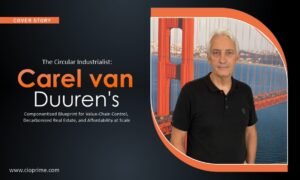
Once in a while, there arises a leader who challenges the long-established norms. In the real estate industry, Carel van Duuren, breaking those traditional developmental norms, is reshaping the global housing landscape by implementing strict financial logic and systems thinking. He started his professional journey in the financial sector. During that time, he also gained extensive auditing experience and expertise in financial management. Throughout his tenure at EY, he managed major U.S. corporate accounts, gaining invaluable experience in global finance that taught him how to analyze capital efficiency and process risks at scale.
In 1990, he took the entrepreneurial leap and founded Kairos Business Support, a firm dedicated to interim management, executive leadership, consulting, and coaching. Over thirty years, he completed numerous high-level corporate turnarounds. In his establishment of Kairos Holding BV in 1991, a principal holding company that would become the umbrella for numerous ventures across different industries, his entrepreneurial spirit gained a shining edge. This diverse corporate background taught him how to dissect complex industrial supply chains, strip away operational waste, and anticipate macroeconomic shifts before they impact product delivery.
The Transition From Volumetric Limits to True Modularity
Carel van Duuren entered the real estate sector after discovering the physical restrictions of existing volumetric building setups. In 2004, he joined Kessel Rental BV as General Manager, providing many world-famous brands with temporary kitchens and restaurants during major construction and renovation projects. In 2015, he founded NxtGen Smart Modular Building BV, a Dutch rental company specializing in high-quality, demountable professional kitchens. This practical exposure to temporary structures highlighted the structural limitations of volumetric building methods, which frequently require heavy investments in factories, create massive overhead costs, and face severe transportation difficulties when moving fully assembled units across global borders.
Combined with his awareness of the global housing crisis and construction’s environmental impact, Carel van Duuren decided to develop a universal solution as a long-term legacy project. His venture, NxtGen Houses Holding, serves as the overarching entity managing the True Modular Building (TMB) Group of companies, which he built around sustainable, industrialized modular construction to provide a viable alternative to legacy brick and concrete methods.
Decompressing the Value Chain via the Orange Kit Framework
By controlling the entire value and supply chain, Carel van Duuren ensures cost efficiency, reduced environmental impact, and superior quality in real estate projects. TMB rejects the concept of short-term profits, choosing instead to decompose traditional buildings into simple, interchangeable modules managed like pieces of a jigsaw puzzle. The main enabler of this system is the Orange Kit framework, a highly adaptive, plug-and-play, componentized construction method.
This universal system transforms buildings from being a source of greenhouse gas emissions into carbon-storing structures by utilizing multi-layer wall panels packed with bio-based insulation like flax, cellulose, and hemp. Because the componentized pieces fit into standard shipping containers, TMB flatpacks its buildings to any destination worldwide without requiring specialized heavy machinery or highly scarce construction labor on site. This flexible architecture balances mass standardization with individual customer preferences, allowing global communities to configure over sixty residential designs straight from a digital catalog.
The Emergence of a Modern Systemic Mission
Carel van Duuren’s move into real estate was not a conventional career plan but the result of a problem that “found” him. He became increasingly concerned by the shortage of affordable housing and the waste, cost, and rigidity of traditional construction. His practical frustration with expensive and inflexible modular solutions triggered the development of a new building system. What began as an operational challenge evolved into a personal mission: to help decarbonize the built environment while making healthy, affordable housing more accessible. He realized that the traditional property sector could no longer ignore its mounting structural waste, prompting him to combine his deep operational management experience with raw materials science to change standard building practices.
Systemic Shifts and the Definition of True Innovation
Carel van Duuren defines innovation as systemic change, not technology for its own sake. Real estate innovation should improve cost, speed, quality, sustainability, and long-term value at the same time. TMB’s Orange Kit embodies this approach through reusable, releasable components, bio-based insulation, digital preparation, and design for disassembly. For Carel van Duuren, innovation also requires long-term ownership thinking: developers should remain responsible for buildings beyond delivery, ensuring that design, maintenance, and material choices support durability and circularity. This philosophy challenges the standard real estate model of building fast for short-term sales, replacing it with a circular framework where materials return to the industrial loop at the end of their useful lifecycle.
Navigating Megatrends and Industrialized Validations
The sector is being transformed by converging pressures: housing shortages, climate regulation, labor scarcity, digitalization, and more demanding customers. Sustainability is becoming mandatory as construction faces pressure to reduce energy use, waste, and carbon emissions. At the same time, modular and off-site construction are gaining ground because they can reduce timelines and dependence on scarce skilled labor. Digital tools such as BIM, smart buildings, and data platforms are changing design, construction, operations, and investment. These trends validate TMB’s industrialized, sustainable model, positioning the firm as a reliable partner for institutional funds that require verifiable carbon reductions. Carel van Duuren continues to monitor these global market shifts, testing new structural configurations to expand his component network into dense urban centers.
Transitioning Real Estate to Data-Driven Operating Models
Technology is turning real estate into a data-driven operating business rather than only an asset business. Carel van Duuren observes this macro shift firsthand as digital tools alter how global property portfolios perform across their entire lifecycle. Within his executive framework, building information modeling and digital twins allow buildings to be planned, tested, and optimized before construction begins on the physical site. This preemptive virtual analysis eliminates costly design collisions and material waste long before any components arrive at a project location.
Furthermore, embedded Internet of Things sensors and smart building systems provide real-time insight into energy use, maintenance, utilization, and user experience. By streaming these deep metrics into centralized platforms, True Modular Building connects leasing, finance, operations, marketing, and analytics, reducing traditional organizational silos and improving corporate decision-making. This technological integration is also reshaping transactions, procurement, financing, and investor access through modern PropTech and FinTech solutions, enabling real estate funds to manage their assets with the precision of high-yield technology portfolios.
Asset-Light Scaling and the Alignment of Global Interests
TMB’s competitiveness comes from combining proprietary intellectual property with an asset-light scaling model. Carel van Duuren deliberately avoids the heavy financial drag of traditional manufacturing ownership by decoupling design from physical factory production. Under his direction, the company controls its designs, specifications, quality standards, and building logic while using partner factories and joint ventures to expand internationally. This structural flexibility ensures that its foundational Orange Kit system is adaptable to local regulations, climates, and customer needs while remaining standardized enough for efficient production and logistics across varying territories.
TMB also differentiates itself through deep sustainability, long-term co-ownership, patient capital, and a corporate philosophy that treats other modular builders as allies in transforming construction rather than as direct competitors. This collaborative approach allows Carel van Duuren to enter new international regions rapidly, utilizing existing local industrial capacity to scale his componentized framework without incurring major capital expenditure or fixed overhead costs.
Fusing Commercial Scale with Environmental Balance
TMB aligns business growth with sustainability by making both depend on the same system. Carel van Duuren constructs his commercial model so that environmental milestones directly generate financial savings for the enterprise and its institutional partners. Reusable modular components reduce material waste, lower setup costs, and preserve high residual value for the building structure over time. Bio-based materials help store carbon effectively, while design for disassembly allows buildings to be adapted, relocated, or reused over multiple lifecycles instead of being demolished.
The company’s co-ownership model ensures that affordability, energy performance, and material responsibility remain important after completion. Because TMB grows through local co-makers rather than large centralized factories, it can also reduce transport intensity and fixed industrial overhead. Carel van Duuren tracks these operational metrics closely from his corporate office, evaluating how this decentralized network can support the next wave of affordable housing projects across Europe and North America.
Formative Decisions and the Realities of Corporate Leadership
Carel van Duuren has repeatedly faced difficult leadership choices such as dismissing employees, closing or relocating companies, starting over after setbacks, and coping with serious health challenges. He does not view these stressful moments as purely negative events, but rather as formative experiences that shaped his executive character. These challenges influenced a leadership style built on clarity, fairness, resilience, direct communication, and the ability to distinguish true persistence from investing in a sinking ship. He brings this same level of clear-eyed honesty to his environmental commitments, viewing the decarbonization of the built environment as a non-negotiable leadership priority. His past experiences teach him to cut through corporate posturing, allowing him to guide his executive team with a balanced mix of professional empathy and firm operational discipline.
The Marriage Model of International Investment
TMB builds relationships through alignment, transparency, and long-term commitment. Carel van Duuren deliberately compares funding partnerships to a marriage, noting that the right partners must believe in long-term value rather than only short-term returns. To protect the company from volatile market swings, TMB seeks patient capital from governments, pension funds, and family offices that prioritize generational wealth over immediate exit timelines. The company develops joint ventures with local partners who bring essential market knowledge, labor, capital, and project access to the table. This collaborative model gives international partners real participation rather than a simple supplier or distributor role. By prioritizing open communication, co-ownership, and shared sustainability goals, Carel van Duuren strengthens institutional trust across geographic borders, turning international financiers into deeply invested advocates for the modular framework.
Redefining Customer Experience in Shared Communities
Customer experience is becoming a decisive factor in real estate’s future. Carel van Duuren recognizes that modern buildings are no longer just physical products sitting on a plot of land, but must actively deliver comfort, flexibility, services, identity, and community. This customer shift applies especially in a world where work, shopping, and living patterns have changed dramatically over recent years. Real estate companies must understand users continuously, integrate digital and physical touchpoints smoothly, and improve spaces over time based on actual usage data. TMB applies this human-centric strategy through affordable, sustainable communities, long-term co-ownership, and active tenant engagement. This management method turns regular residents and institutional investors into active stakeholders who participate in the long-term governance of their neighborhoods, ensuring that the properties remain relevant and desirable. Carel van Duuren continues to review the feedback loops from these early pilot communities, adjusting his universal design metrics to support the next wave of international neighborhood developments.
The Technical Breakthrough That Shifted a Corporate Path
A major milestone that fundamentally transformed his corporate trajectory was the development of the patented NxtGen modular building system in 2016. This technical breakthrough grew directly out of Carel van Duuren’s practical experience with temporary modular structures, where he spent years observing the logistical inefficiencies and structural rigidities of traditional setups. The creation of this system became the operational foundation for TMB’s later Orange Kit platform, proving to the wider real estate market that modular components could be designed as completely reusable, interoperable, and scalable building elements. This milestone marked a profound shift in his professional journey, steering his career away from general entrepreneurship and temporary interim leadership roles. It anchored his focus onto a mission-driven dedication to affordable housing, environmental sustainability, and industrialized construction, giving him a distinct competitive edge in the international real estate market.
Pragmatic Advice for the Next Generation of Property Leaders
Carel van Duuren’s advice for emerging executives entering the global property sector combines intense persistence with grounded operational realism. He encourages next-generation leaders to stay curious, act decisively when unique market opportunities arise, and regularly evaluate whether their commercial proposition still fits the changing demands of the market. He frequently warns his management teams that raw ideas represent only a small part of true corporate success. Instead, the rigorous details of daily execution, product packaging, accurate pricing, multi-state logistics, local zoning regulations, and immediate market readiness ultimately determine whether an innovation successfully reaches end customers. He also strongly stresses the necessity of value chain control, long-term strategic thinking, environmental responsibility, and the personal courage required to leave failing ventures behind before they drain institutional resources. Above all, he believes that leaders must walk their talk and lead by example across every level of operation.
The Decade Vision for Decentralized Property Capital
Carel van Duuren’s vision for the next decade centers on a real estate industry that prioritizes people, affordability, sustainability, and long-term value over short-term speculative profit. He views the global shortage of affordable housing and the rapid decarbonization of traditional building methods as the defining leadership challenges of the modern property sector. True Modular Building seeks to prove to international markets that healthy, sustainable, modular communities can be both highly commercially viable and globally scalable. This future depends on the widespread adoption of true modularity, the cultivation of local co-maker manufacturing networks, the engagement of patient capital, and long-term co-ownership models. To expand this reach even further, Carel van Duuren explores how emerging financial instruments can democratize property access, looking closely at how fractional and tokenized ownership models can allow everyday residents to build real equity in the very neighborhoods they inhabit.
Read Also : Dr. Colleen Georges’ RESCRIPT Revolution: Reclaiming Leadership Through the Power of Internal Narrative