A Disciplined Expert – Dr. Enrika Uusitalo: Guiding International Companies in Baltic-Nordic Energy Transitioning, Offshore Wind, and Market Entry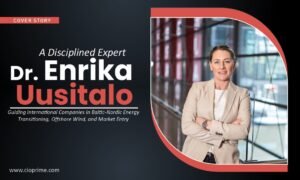
Human history is the foundation on which is built the future of humanity, believes Dr. Enrika Uusitalo, the Chief Executive Officer (CEO) at EU Imperium Consulting Oy. History inspires her. “It also reminds me that tomorrow is shaped by the leadership of today.” That is why she is recognized globally as one of the most inspirational women to follow. Dr. Enrika Uusitalo feels deeply honoured to contribute to meaningful structural impact.
A recognized expert in offshore wind, port marshalling, market entry, and Nordic-Baltic energy infrastructure development, Dr. Enrika Uusitalo specializes in guiding international companies – from EPC contractors to technology providers into the Finnish, Baltic, and Nordic renewable-energy and other sectors.
With a doctoral degree in Global Business Administration from the Swiss School of Business and Management Geneva, and a decade of cross-border project, academic, and consulting experience, Dr. Enrika Uusitalo plays a dual role: she continues to represent Sarens NV in Baltic–Nordic offshore-wind heavy-lift and port projects, which gives her a unique view on both the developer and contractor sides. She combines rigorous academic insight with hands-on industry execution. She speaks the language of engineers, port authorities, heavy-lift contractors, developers, and regulators — enabling effective collaboration across disciplines and borders.
Turning Knowledge into Impact
In her own words, her mission is to turn knowledge into impact: supporting sustainable, efficient, and future-ready offshore-wind infrastructure across the Baltic–Nordic region, while bridging international expertise with local execution.
Sharing her views on the current energy demand globally, Dr. Enrika Uusitalo says, “As we all can see, renewable energy is no longer merely an industry; it has become a strategic necessity.” Whether framed through energy security, offshore wind expansion, decarbonisation targets, or the UN Sustainable Development Goals, it defines the urgency of our time and our collective responsibility to reduce emissions while preserving long-term economic resilience.
The Long-Term Vision
Dr. Enrika’s long-term ambition is to operate at the policy–strategy interface where infrastructure, sustainability, and economic stability converge. Ports, energy systems, and supply chains are no longer technical components of industry — they are instruments of geopolitical balance and regional competitiveness.
“We are living in a decade where infrastructure decisions determine generational outcomes,’ she adds, with her work sitting at the intersection of strategy, engineering, and leadership, ensuring that systems are structurally ready before ambition outpaces execution. For her, impact means enabling structural change and implementation.
The complexity of this sector does not intimidate me; it energizes Dr. Enrika. “Building resilient systems that can withstand economic turbulence and geopolitical shifts is what drives and inspires me every day.”
The Pivotal Moment
Further sharing a pivotal moment in her early life that first sparked her passion for leadership and convinced her that she could thrive in this field, Dr. Enrika Uusitalo says that leadership, in many ways, was inherited. Her father was charismatic, optimistic, fascinated by engines and speed, and deeply connected to people. “Some features in me are direct reflections of him.”
From kindergarten, she preferred cars over dolls. At 14, she decided she wanted to enter a military academy and began volunteering in the army. “That period shaped my resilience, stamina, discipline, and understanding of hierarchy and responsibility.” Leadership, for Dr. Enrika, became clear very early: responsibility equals leadership. It is not an authority. It is not a title. It is understanding the weight of decisions and the consequences they have for your team, your organization, and sometimes even for society. You do not have to be motivated. You have to be disciplined. Motivation fluctuates. Discipline builds leaders, she insists.
People and History Are Her Guide
To the question of the most influential female mentors she adores, Dr. Enrika Uusitalo replies, “I would say mine is a two-fold answer. On one side, I have been influenced by strong women in professional environments who demonstrated calm authority without emotional instability. I respect leaders such as Ursula von der Leyen, who combines family and her career in total balance. I have learned a lot from her approach to the issues, viewing strategic resilience well, and structural reform in turbulent times. Her calm, institutional leadership matters more than charismatic noise.”
On the other side, history itself has been Dr. Enrika’s mentor. “We are facing turbulent times in the economy, power shift, trade, and purchasing power shift at a time when young people, the generation that is facing good times as well, are losing resilience and possibly creating more turbulence and difficult times.”
Studying historical cycles, especially the 19th and 20th centuries, gives perspective and understanding for the upcoming future cycles. If you do not understand history and structural shifts of previous centuries, you will be set to struggle to mitigate current turbulence and plan for the future. History moves in cycles. Power shifts. Economic rebalancing of industrial transitions. What changes is technology; what remains is human behavior. Understanding this creates strategic calmness and inspires the most.
The Primary Importance of Human Connection
In a continuously dynamic world, for Dr. Enrika, gender is not the primary factor. It is a connection between individuals: how you approach, how you listen, and try to understand the matter instead of thinking about what to respond (One of the biggest communication issues today is that people are not listening to understand — they are listening to respond). A big part of the decisions is understanding cultural differences, which might affect or have a different point of view between people. “My strength, as I think, is to be transparent, honest with people, and not be led by emotions. Think before responding.”
She adds that her personal strength is transparency and calmness under pressure. She does not allow emotions to affect decisions. She tries to think before responding and understands the other person’s position and point of view.
Learning from the Past
However, world reality is different. describing a time when she faced gender-based bias or skepticism as a leader, Dr. Enrika Uusitalo reveals that the army was the strongest test. It presented two options: you leave as a leader, or you leave broken. She decided fast: chose leadership where she learned to separate emotions from performance. “I trained my body and my mind.” Stoic philosophy became an anchor. The lesson was clear: external opinions do not define internal strength. In alpha-driven industries such as heavy infrastructure and energy, skepticism still appears occasionally. “But I hold my ground. If feedback is constructive, I learn. If it is noise, I ignore it.”
“What people say does not change who I am. Often it reveals more about them than about me. Resilience is built through friction. Experience in the army taught me resilience and knowing who I am, where I am headed helps a lot.”
A Progressive Present
Yet, Dr. Enrika Uusitalo sees big progress in gender balance in leadership, advisory, and board positions. There is measurable progress, especially in the Nordic region, she informs.
Board gender balance reflects institutional commitment to equality, with Norway enforcing a binding 40% quota and other countries implementing EU-aligned 40% targets by 2026. This demonstrates that diversity is not symbolic. It is considered a structural component of governance quality and long-term competitiveness.
However, legislation alone is not enough, feels Dr. Enrika. Cultural maturity must follow actual change and implementation. “Globally, we are losing tolerance not because people care less, but because digital acceleration, economic uncertainty, and polarization are outpacing our ability to reflect, empathize, and engage in constructive dialogue.” In such conditions, disagreement is perceived as a threat rather than a difference. Leadership today must restore tolerance, perspective, and constructive discourse.
The Need for Positive Leadership
Dr. Enrika Uusitalo further insists that at the moment when we must remain united and think in the big picture, individually, leadership becomes essential. “We have all the necessary tools to be global, to communicate, and to create a positive impact. But tools are not enough.” Positive leadership is needed to guide younger generations, and gender equality is a big part of it. “In this case, improvement is relatively easy: we are all part of the problem, and we are all part of the solution.”
To cultivate and empower other women on her team to step into leadership roles, Dr. Enrika Uusitalo herself always tries to see the best in people and support their growth. “Listen to their needs, wishes, and finally, it is not about gender as I mentioned before.” If a person is a specialist and professional at what they do, that’s what matters.
“Respect for people and respect for nature, since we are part of both,” are the core values guiding her daily leadership decisions. “Then comes discipline and responsibility. Leadership must consider both,” she adds.
Nonetheless, in a demanding profession such as that of the energy sector, balancing leadership demands with personal life (such as family or self-care) changes one’s definition of success. When asked about the strategies she adopted to maintain that equilibrium, Dr. Enrika Uusitalo says, “First of all, I am fortunate to have a husband who is also an international business leader. We speak the same language: strategy, responsibility, global perspective.”
“Have to admit, balancing leadership, travel, study, and entrepreneurship is demanding. There have been moments when slowing down was necessary.”
There is no universal strategy for families that fits all. The foundation is openness and communication. At the end of the day, success is not only measured in professional milestones. It is measured in the strength of relationships and inner stability; this is what Dr. Enrika Uusitalo tries to keep and remember. “Even when I am somewhere in the world working to improve systems and structures, I know I have a stable foundation at home that is my husband, and I know it is the most important human being I should care for.”
The Future Past of the Present
In response to a tricky question, ‘What bold risk has she taken in her career that paid off, and looking back, what advice would she give to her younger self about embracing uncertainty as a woman leader,’ Dr. Enrika Uusitalo says, “Good question. I was always a true seeker and fighter for the rights of a better future and those who need help. And, of course, have made several risky steps.” One success story she would like to share is that she is still building, but already enjoying with full heart: after relocating herself to Finland, and later opening her own company.
Dr. Enrika Uusitalo had a position in a Finnish company with a strong integration pathway. But she realized she wanted to create an impact on a different scale.
So, she established her own company to implement change on her own terms, for herself, for the region, for cross-border cooperation. “Risky decision required a lot of work, energy, and time from myself and from my family to generate new ideas, and at the same time, it gave me a lot of freedom.” Freedom to make an impact, to help companies, and choose which projects she and her team want to work on, and how to do it. “We do amazing things with my team, and results are always rewarding since we are living in turbulent times: economic power shifts, trade realignment, declining resilience among younger generations who grew up in stable conditions,” she shares.
Failure That Taught Her the Greatest Lesson of Her Life
Once again, when asked to recount a leadership failure early in her career and to explain how it transformed her style or decision-making process, Dr. Enrika Uusitalo admits that it is a good question. She answers, “Early in my career, I tried to solve everything alone. I believed strong leaders must carry all the weight and micromanage everything. That was a mistake.”
Later on, she understood that leadership is not about centralizing control. It is about structured delegation. Again, in a team, company, international project, or organization – same as every asset in a supply chain has its defined place, every team member must understand their role to deliver maximum value, and good leader is the person who sees where is the right place for each individual to enjoy, to love what they do and bring best of the result. This is the only way to succeed. “Failure taught me that distributed responsibility creates stronger systems.”
Dr. Message for Aspiring Women Leaders
In her address to aspiring women leaders in one sentence, a message which resonates with her own path, Dr. Enrika Uusitalo says: “Do not wait to feel motivated, be disciplined, understand history, and bravely take responsibility, and remember that your impact is defined by who you are, not by noise around you, that’s the value you consistently create.”